 SkilletLore
Rust Removal & Chemical Stripping
Vinegar and rust: why exposure needs control
The strength of household vinegar and the condition of a pan both vary.
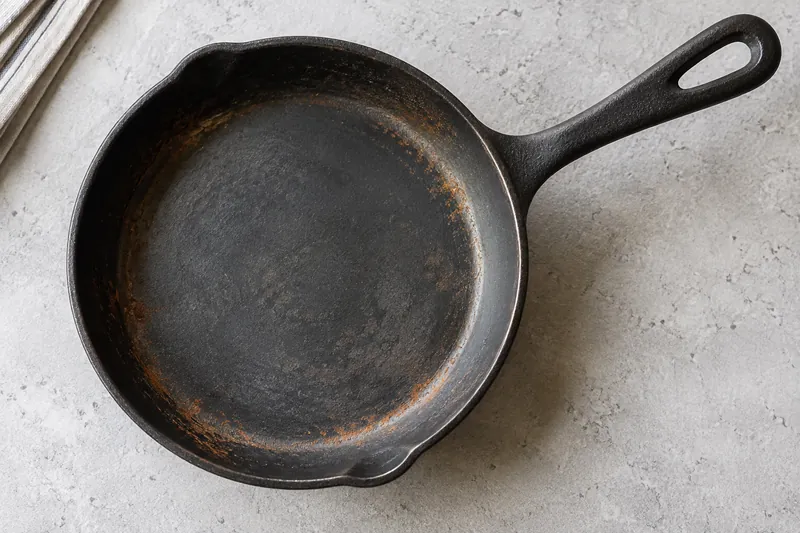
Before you start
The strength of household vinegar and the condition of a pan both vary. A fixed soak time copied from another restoration cannot distinguish rust removal from ongoing attack on exposed metal. If the item is valuable or its finish is uncertain, get advice before putting the whole piece into acid.
When home cooks discover a rusty skillet in a garage or thrift store, the most common internet advice is to submerge the pan in a bucket of household white vinegar (5% acetic acid, CH₃COOH) for several hours—or even overnight. Restoration workshops regularly receive 19th-century Griswold and Wagner skillets ruined by multi-day vinegar baths: the factory machining swirls are etched away into a dull, chalky sponge of soft black graphite, and the rim or pour spout has developed hairline cracks. Understanding the competing reaction kinetics of acid pickling, graphite-ferrite galvanic coupling, and atomic hydrogen absorption explains why vinegar must be restricted to strictly timed 20- to 30-minute intervals. Compare acid pickling against lye and electrolysis in our Cast Iron, Carbon Steel & Clad Stainless Defect Diagnostic Matrix.
The Dual Reaction Trap: Why Acetic Acid Attacks Bare Iron
Household distilled white vinegar is a 5% w/v (~0.83 M) aqueous solution of acetic acid (CH₃COOH, pK_a = 4.76). Diluted 1:1 (50/50) with tap water, the solution has a molarity of ~0.42 M and a pH of approximately 2.56.
When you immerse a rusted skillet into this pH 2.56 bath, the acid does not “wait” until all red rust (Fe₂O₃ / FeO(OH)) is gone before attacking the underlying metallic iron (Fe⁰). Both reactions occur simultaneously wherever liquid contacts the surface, and Reaction 2 (metallic iron dissolution) is thermodynamically more spontaneous (ΔG° < 0) than Reaction 1:
Reaction 1 — Desired Dissolution of Ferric Oxide Rust (Slow, Non-Gas-Evolving):
  Fe₂O₃(s) + 6 CH₃COOH(aq)  ──>  2 Fe(CH₃COO)₃(aq) (soluble ferric acetate) + 3 H₂O(l)

Reaction 2 — Destructive Dissolution of Bare Metallic Iron (Fast, Evolves H₂ Gas):
  Fe⁰(s)   + 2 CH₃COOH(aq)  ──>  Fe(CH₃COO)₂(aq) (soluble ferrous acetate) + H₂(g)↑

Reaction 3 — Reductive Dissolution Auto-Coupling (Rust Accelerates Iron Loss!):
  Fe⁰(s)   + Fe₂O₃(s) + 6 CH₃COOH(aq)  ──>  3 Fe(CH₃COO)₂(aq) + 3 H₂O(l)
Notice Reaction 3: where patches of red rust sit next to bare iron, the ferric oxide acts as a cathodic oxidizer that accelerates the anodic dissolution of the adjacent bare metallic iron! If you see tiny bubbles (H₂↑) fizzing steadily off a skillet in a vinegar bucket, you are watching metallic iron dissolve into solution.
Micro-Galvanic Pitting & Graphitic Corrosion in Gray Cast Iron
Why does over-soaking in vinegar damage gray cast iron (ASTM A48) far faster than rolled mild steel? Gray cast iron contains 2.8% to 3.5% carbon by weight, which occupies roughly 10% to 12% of the metal’s volume as interconnected microscopic graphite flakes dispersed through an iron (α-ferrite / pearlite) matrix.
In an acidic electrolyte (pH 2.56), graphite and alpha-ferrite sit at opposite ends of the galvanic series:
- Lamellar Graphite Flakes (Cathode): Standard electrode potential
E° ≈ +0.20 to +0.35 V(electrochemically noble, like platinum or gold). Graphite is completely insoluble in acetic acid and acts as an efficient catalytic surface for hydrogen ion reduction (2H⁺ + 2e⁻ → H₂↑). - Alpha-Ferrite Iron Matrix (Anode): Standard electrode potential
E° = -0.44 V.
This ~0.70 V potential difference turns every square millimeter of the skillet surface into thousands of short-circuited micro-galvanic cells. The acetic acid selectively dissolves the iron grains right next to each graphite flake—a metallurgical failure mode known as graphitic corrosion (or graphitization). After a 12-hour vinegar soak, the skillet may still hold its shape, but the top 0.2 to 0.8 mm of metal has been converted into a porous, spongy skeleton of graphite flakes that rubs off black on your fingers and can never hold a durable seasoning bond.
Immersion Duration (50/50 Vinegar, 70 °F) |
Chemical & Metallurgical Effect on Cast Iron | Workshop Verdict |
|---|---|---|
10 to 20 minutes |
Dissolves thin orange flash rust and loosens light surface scale with minimal Fe⁰ attack. |
Safe Window — brush and inspect at 15 min. |
20 to 30 minutes |
Dissolves moderate red rust; minor micro-etching of bare iron peaks (R_a increases slightly). |
Absolute Maximum Per Cycle — rinse & scrub. |
1 to 3 hours |
Active H₂↑ fizzing; micro-galvanic etching around graphite flakes; factory swirl marks blur. |
Damaging — visible dull gray-black acid etch. |
8 to 24+ hours (Overnight) |
Deep graphitic corrosion (spongy carbon layer), crater pitting, and atomic hydrogen uptake. |
Catastrophic — ruins vintage collector castings. |
Atomic Hydrogen Uptake and Stress-Relief Cracking
During acid pickling (Fe⁰ + 2H⁺ → Fe²⁺ + 2H_ads), before two adsorbed hydrogen atoms combine into a harmless H₂ gas bubble, a fraction of nascent monatomic hydrogen (H⁰) diffuses directly into the iron crystal lattice, collecting at high-stress grain boundaries and the sharp tips of graphite flakes.
Inside microscopic voids around graphite tips, H⁰ atoms recombine into molecular H₂ gas at internal pressures exceeding 1,000 atmospheres, causing hydrogen embrittlement. If a thin-walled vintage skillet already harbors residual casting stress near the handle base or pour spout—and is then placed directly into a 450 °F seasoning oven—that trapped hydrogen pressure plus thermal stress can snap the sidewall with an audible ping. (If a pan was accidentally over-soaked in acid, bake it bare at a gentle 300–350 °F / 149–177 °C for 2 hours first so diffused hydrogen effuses safely out of the lattice.)
The Safe 20-Minute Vinegar Protocol & Baking Soda Neutralization
Note first what vinegar cannot do: acetic acid cannot saponify or dissolve polymerized oil. If a rusty pan also has baked-on black grease, strip the grease first in a Sodium Hydroxide Lye Bath or use a 12V DC Electrolysis Tank (which removes both rust and grease with zero acid etching).
If you only have light-to-moderate surface rust and choose to use vinegar:
- Mix
50/50Cold Solution: Combine equal parts distilled white vinegar (5%acidity) and cold tap water in a plastic basin (final acidity ~2.5%). Never heat the vinegar bath. - Set aHard 20-Minute Timer: Submerge the clean, degreased skillet and set a physical alarm for 20 minutes. Do not walk away without a timer.
- Scrub & Inspect: Pull the pan at 20 minutes and scrub under cold running water with fine
0000steel wool or a stiff nylon brush. If stubborn rust spots remain in recessed logos, dab vinegar locally with a soaked rag or run one more 15-minute cycle—never leave the whole pan soaking while waiting on a single rust pit. - Mandatory Alkaline Neutralization (
NaHCO₃): Dissolve2 tablespoonsof baking soda (NaHCO₃) in1 quartof cold water and wash the entire pan (CH₃COOH + NaHCO₃ → CH₃COONa + H₂O + CO₂↑) to neutralize residual acid trapped inside microscopic graphite pockets. - Immediate Oil Wipe Against Flash Rust: Dry thoroughly with a lint-free towel and immediately rub
1 teaspoonof grapeseed or canola oil (Oil Smoke Point & Polymerization Matrix) across every surface before placing the pan in the oven.
Practical check: what to observe
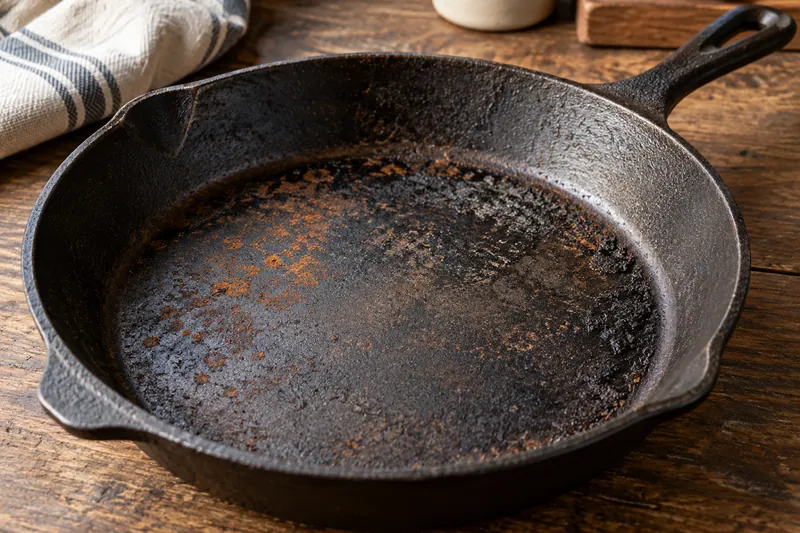
Inspect before and during any permitted treatment and stop when the intended deposit is removed. Existing pits remain pits after cleaning. Photograph them so later changes can be distinguished from old damage; a smoother-looking surface does not prove restored structural integrity.
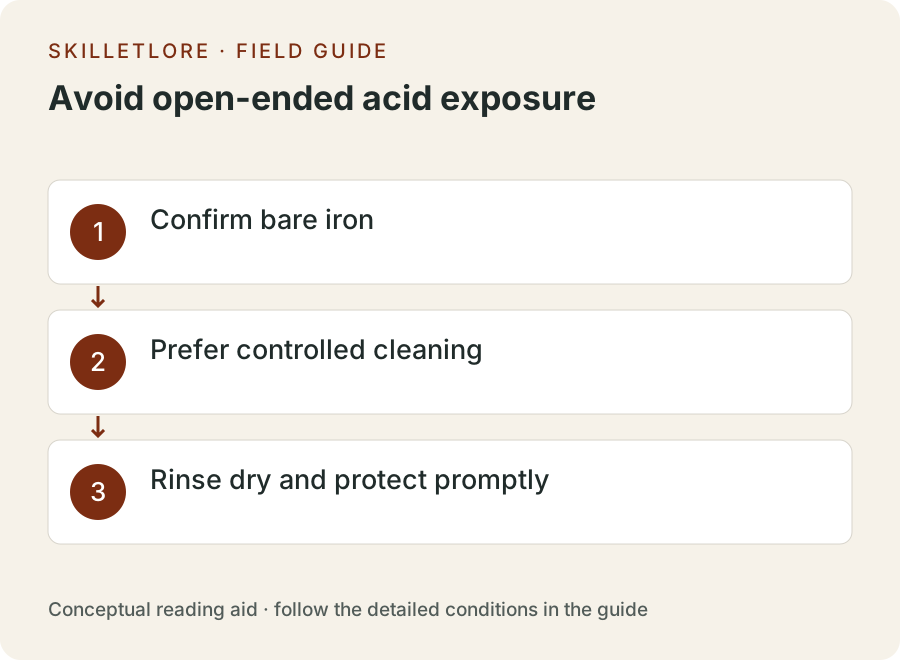
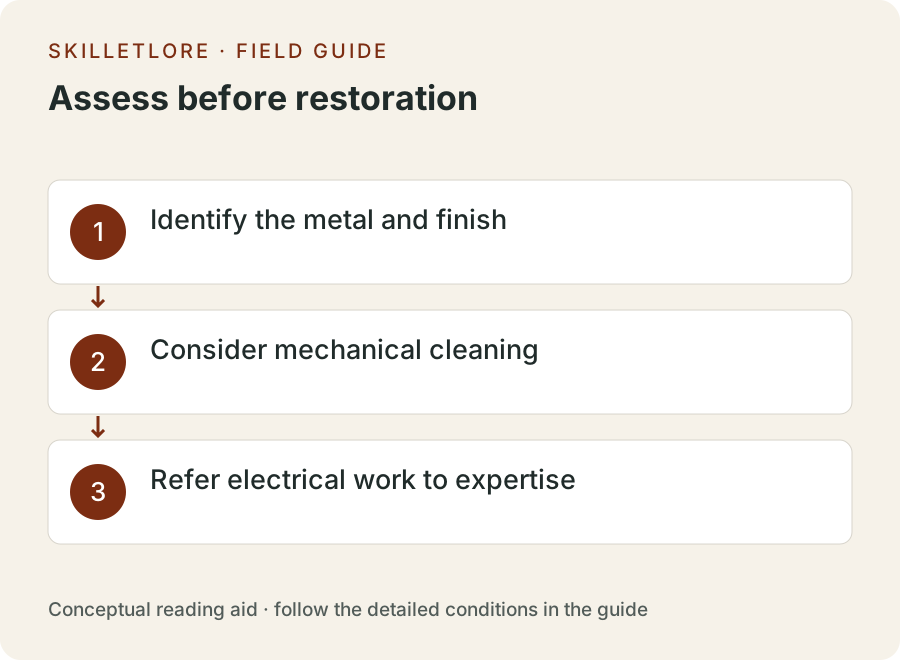
- Confirm bare iron
- Prefer controlled cleaning
- Rinse dry and protect promptly
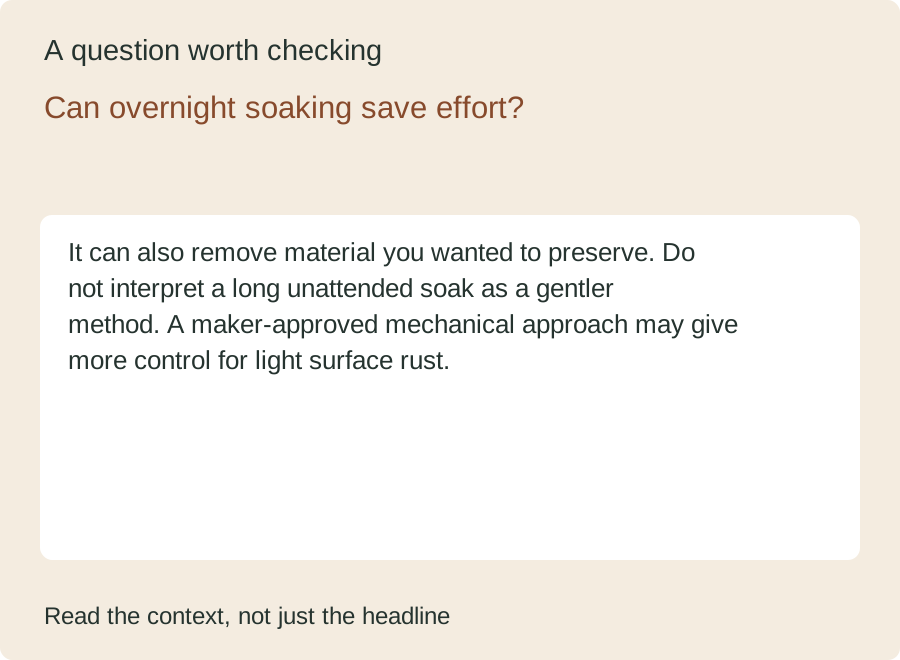
Can overnight soaking save effort?
It can also remove material you wanted to preserve. Do not interpret a long unattended soak as a gentler method. A maker-approved mechanical approach may give more control for light surface rust.
For more context, see the topic FAQ and glossary. A reference value or example should be read with its units, assumptions and product-specific conditions.
Sources and scope
The references below were supplied with the original manuscript. A reference is not evidence that every numerical claim has been independently checked. See the source library and our verification status.
- ASM Handbook Volume 13A – Corrosion: Fundamentals, Testing, and Protection (Acid Pickling of Cast Iron)
- Corrosion Science – Galvanic Coupling Between Lamellar Graphite and Ferrite in Gray Cast Iron
- Canadian Conservation Institute (CCI) Note 9/1 – Recognizing Active Corrosion and Acid Cleaning Risks on Iron
Put the explanation to work
Continue reading
Spot a questionable claim or a calculation issue? Read our correction process and contact information. Examples and illustrations are educational; they do not establish product suitability or a laboratory result.