 SkilletLore
Rust Removal & Chemical Stripping
Lye stripping: what it removes and what it does not
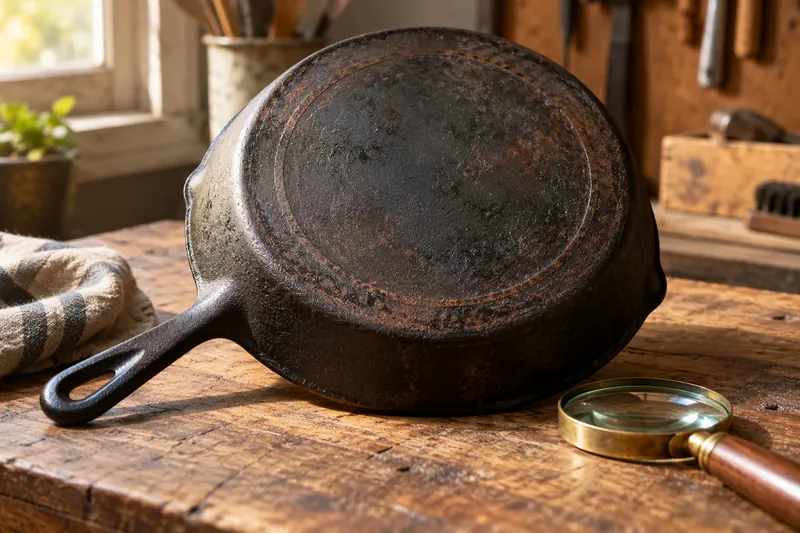
A black crust and orange corrosion are different materials.
Before you start
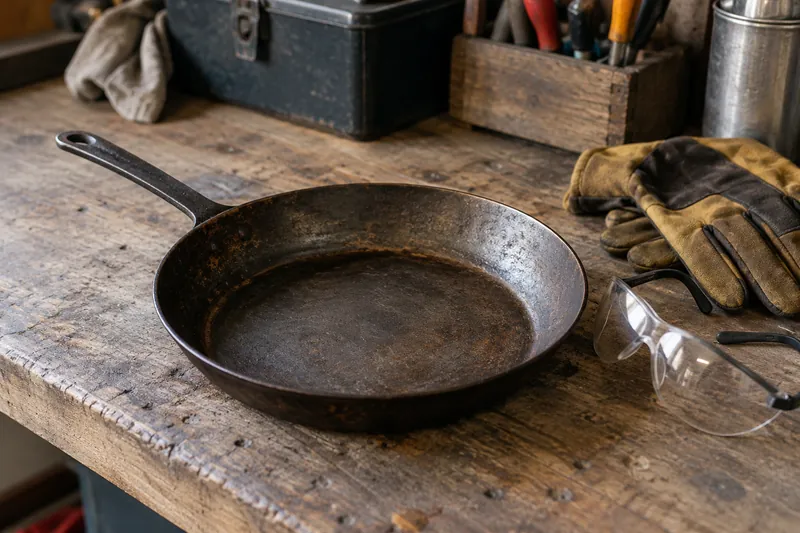
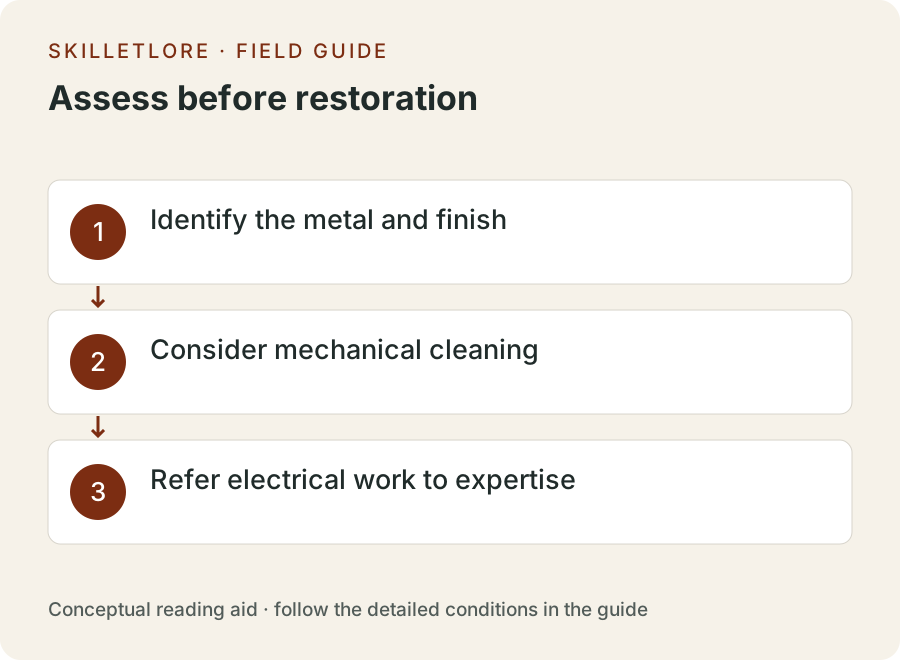
A black crust and orange corrosion are different materials. A process that removes old organic deposits does not necessarily remove rust, and cleaning a pan does not repair a crack. Before considering a caustic stripping process, establish what the object is made from and whether a simpler cleaning method is sufficient.
When a 1920s Griswold or Wagner skillet emerges from an estate sale encased in 3 millimeters of rock-hard, carbonized black grease along the outer sidewall and heat ring, mechanical scraping or wire-wheeling will scar the iron and ruin its collector value. Self-cleaning oven cycles (850–950 °F) risk warping the thin casting floor into a “spinner.” The safest, most selective method for removing decades of polymerized oil and pyrolyzed food crud is alkaline ester saponification in an aqueous sodium hydroxide (NaOH, caustic soda / lye) bath—or, for a single pan, a sealed plastic bag with yellow-cap NaOH oven cleaner. Compare lye against electrolysis and acid pickling across all 18 cookware defects in our Cast Iron, Carbon Steel & Clad Stainless Defect Diagnostic Matrix.
The Chemistry of Saponification: How NaOH Dissolves Cured Seasoning
As established in Polymerization Chemistry: How Drying Oils Bond to Raw Iron, cast iron seasoning is a three-dimensional alkyd-like polymer held together by two primary bond classes:
- Free-radical cross-links (
C–O–Cether andC–Cbridges) joining neighboring fatty acid chains; and - Triacylglycerol ester linkages (
R-C(=O)-O-CH₂-) anchoring all three fatty acid chains to their central glycerol hub.
While neutral dish soap (pH 7–8; see Soap vs. Seasoning) cannot touch ester bonds, a strongly basic solution of sodium hydroxide (NaOH → Na⁺ + OH⁻, pH 13.5–14.0) drives irreversible nucleophilic acyl substitution (saponification):
Base-Catalyzed Triglyceride Saponification Mechanism:
  1. Nucleophilic Attack:
     Hydroxide ion (OH⁻) attacks the electrophilic carbonyl carbon (C=O) of the ester linkage,
     forming a tetrahedral alkoxide intermediate.

  2. Ester Cleavage & Carboxylate Formation:
     The alkoxide expels the glycerol leaving group (R'-O⁻) and deprotonates the resulting
     carboxylic acid irreversibly into a water-soluble sodium carboxylate salt (soap):

     (R-COO)₃C₃H₅ (Polymerized Triglyceride Network) + 3 NaOH (aq)
       ──> 3 R-COO⁻Na⁺ (Water-Soluble Sodium Soap Micelles) + C₃H₅(OH)₃ (Soluble Glycerol)
Once the central glycerol ester hubs are severed, the entire three-dimensional cross-linked mesh collapses. Even the insoluble black amorphous carbon char—which is not chemically saponifiable on its own—was cemented to the skillet by that polymerized triglyceride resin. As the ester binder dissolves into dark brown soap liquor, the trapped carbon dust loses its structural matrix and rinses off under tap water with a soft nylon brush.
Why Bare Iron Is 100% Immune to Lye (The Iron Pourbaix Diagram)
Restorers new to chemical stripping often worry that leaving a cast iron pan in a pH 14 lye tank for two weeks will “eat the metal.” Electrochemistry proves the exact opposite. On the Iron-Water (Fe–H₂O) Pourbaix diagram (plotting electrochemical potential E_H against pH at 25 °C):
- Acidic Regime (
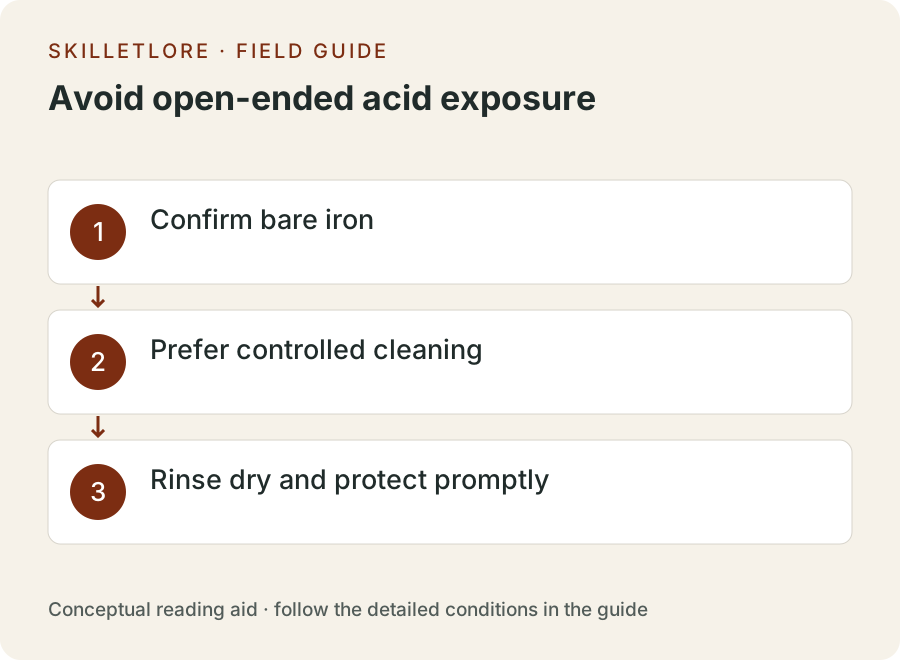
pH < 4, e.g., Vinegar): Metallic iron (Fe⁰) oxidizes spontaneously into soluble ferrous ions (Fe²⁺) with hydrogen gas evolution (Fe⁰ + 2H⁺ → Fe²⁺ + H₂↑). Leaving a pan in vinegar dissolves metal and causes deep pitting; see Vinegar Acid Soaks: Hydrogen Embrittlement and Pitting Time Limits. - Passivation / Immunity Regime (
pH 10 to 14, Lye Bath): BetweenpH 10andpH 13.8, iron forms an ultra-thin, self-limiting passive film ofFe(OH)₂ / Fe₃O₄that halts all anodic dissolution (corrosion rate < 0.002 mm/year). Below-0.8 V,Fe⁰sits in complete thermodynamic immunity.
Crucial Alloy Exception — Never Put Aluminum or Uncoated Enamel in Lye: Unlike iron, aluminum (Al) is amphoteric and dissolves violently in sodium hydroxide, evolving explosive hydrogen gas (2Al + 2NaOH + 2H₂O → 2NaAlO₂ + 3H₂↑). Likewise, prolonged soaking in pH 14 caustic alkali slowly etches the silica network (SiO₂) of glossy porcelain enamel, dulling its factory gloss. Restrict lye baths strictly to bare gray cast iron and bare carbon steel.
Workshop Stoichiometry: Mixing a 5-Gallon NaOH Bath
The industry-standard restoration ratio is 1 pound (453.6 g) of 100% pure crystal sodium hydroxide per 5 US gallons (18.927 L) of cold water:
Molarity and Weight/Volume Calculation (1 lb NaOH in 5 US Gallons):
  • Molar mass of NaOH:         M = 40.00 g/mol
  • Moles of NaOH in 1 lb:      n = 453.6 g ÷ 40.00 g/mol = 11.34 mol
  • Volume of 5 US gallons:     V = 5 × 3.7854 L = 18.927 L
  • Molar concentration [OH⁻]:  C = 11.34 mol ÷ 18.927 L = 0.599 mol/L (≈ 0.60 M)
  • Weight/volume percentage:   % w/v = (453.6 g ÷ 18,927 mL) × 100% = 2.40% NaOH
  • Theoretical pH at 25°C:     pH = 14 + log₁₀(0.60) ≈ 13.78
Mandatory Exothermic Mixing Safety (ΔH_sol = -44.5 kJ/mol)
Dissolving solid NaOH in water is strongly exothermic (ΔH_sol = -44.5 kJ/mol), releasing 11.34 mol × 44.5 kJ/mol = 504.6 kJ of heat. In a full 5-gallon (18.9 kg) cold water bath, that raises the bulk temperature by a gentle 6.4 °C (11.5 °F):
Bulk Temperature Rise in 5 Gallons of Cold Water:
  ΔT = Q ÷ (m_water × c_p) = 504,600 J ÷ (18,927 g × 4.184 J/g·K) = +6.37 °C (+11.5 °F)
However, if you pour a small splash of water onto dry NaOH crystals at the bottom of a bucket, the local water mass is tiny and the solution flashes above 100 °C (212 °F) in a fraction of a second, spraying boiling caustic lye into your face. Always fill the HDPE tub with all 5 gallons of cold water FIRST, then pour the dry NaOH crystals in slowly while stirring with a PVC or polypropylene rod.
| Parameter | Full 5-Gallon HDPE Lye Bath | Yellow-Cap Aerosol (Easy-Off) Trash Bag |
|---|---|---|
| Active Alkali | 2.4% w/v (0.60 M) 100% NaOH |
3% to 5% NaOH foam + alkanolamine cosolvents |
| Best Use Case | Restoring 3+ skillets or Dutch ovens |
Stripping 1 to 2 pans in an apartment/balcony |
| Temperature Kinetic Dependence | Fast at 70–85 °F (24–48 hr); slow below 50 °F (5–7 days) |
Keep sealed black bag in warm shade (70–85 °F) for 24–48 hr |
Removes Red Rust (Fe₂O₃)? |
No — follow with electrolysis or brief 50/50 vinegar | No — saponifies organic grease/polymer only |
| Solution Reusability | Reusable for 30 to 60+ pans over 6–12 months |
Single-use aerosol foam per coat |
Step-by-Step Lye Bath & Post-Strip Flash-Rust Prevention
- Personal Protective Equipment (PPE): Put on ANSI Z87.1 indirect-vent chemical splash goggles, elbow-length butyl or heavy nitrile gauntlets, long sleeves, and closed-toe shoes. Keep a bottle of household white vinegar (
5%acetic acid) nearby solely for neutralizing accidental tool/floor spills (for skin contact, flush immediately with copious running tap water for 15 minutes per NIOSH protocol). - Submersion: Tie polypropylene twine or stainless steel wire through the skillet handle hole and lower the pan into the covered
HDPE #2orPP #5storage tote. Close the locking lid. - Scrubbing & Cold-Water Rinse: After
24 to 72 hoursat room temperature (70 °F), lift the pan out, let it drain over the tote, and scrub in a utility sink with a stiff nylon brush and fine0000steel wool or stainless chainmail. Rinse in dead-cold tap water—hot water accelerates aqueous flash oxidation (4Fe + 3O₂ + 2H₂O → 4FeO(OH)) on bare iron. - Rust Removal & Re-Seasoning: Because
NaOHdoes not dissolve inorganic red rust (Fe₂O₃), transfer any rusted pan to a 12V electrolysis bath (Electrolysis Tank Rust Removal) or a strictly timed 20-minute vinegar soak (Vinegar Acid Soak Limits). Once bare gray iron is clean, towel dry immediately and apply your first coat of grapeseed oil or Crisco using our Cooking Oil Smoke Point & Polymerization Matrix.
Practical check: what to observe
This article explains a mechanism, not a complete chemical-handling protocol. Do not use food containers for chemical storage or treat a bare cast iron procedure as suitable for aluminum, enamel or mixed-metal cookware. Seek specialist restoration advice when identification is uncertain.
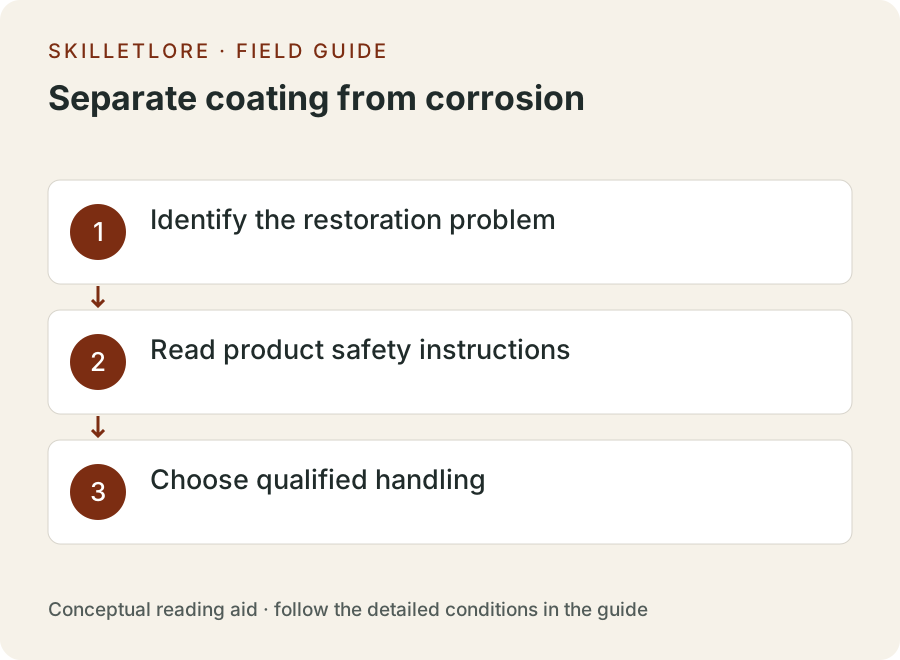
- Identify the restoration problem
- Read product safety instructions
- Choose qualified handling
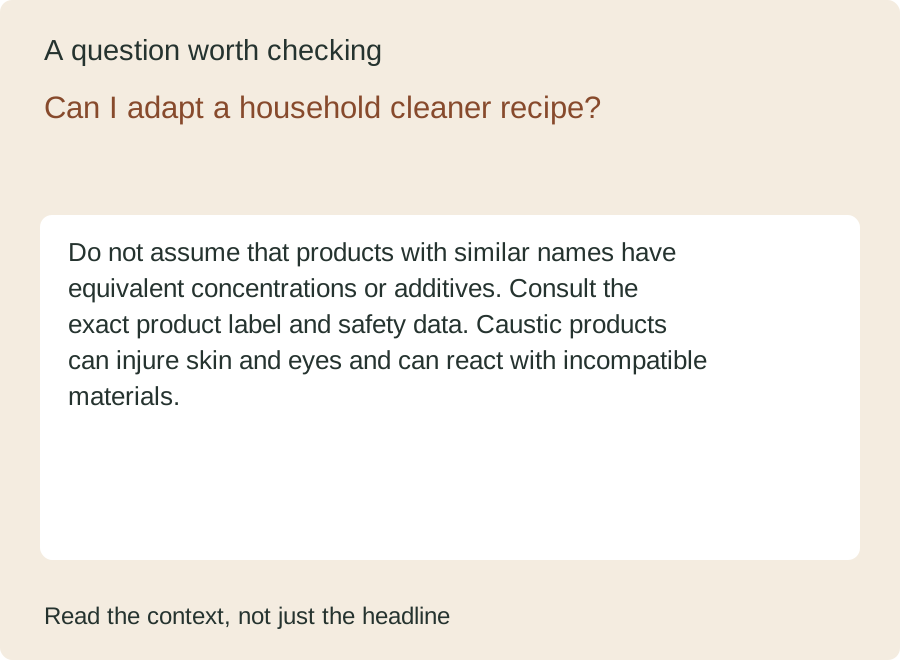
Can I adapt a household cleaner recipe?
Do not assume that products with similar names have equivalent concentrations or additives. Consult the exact product label and safety data. Caustic products can injure skin and eyes and can react with incompatible materials.
For more context, see the topic FAQ and glossary. A reference value or example should be read with its units, assumptions and product-specific conditions.
Sources and scope
The references below were supplied with the original manuscript. A reference is not evidence that every numerical claim has been independently checked. See the source library and our verification status.
Put the explanation to work
Continue reading
Spot a questionable claim or a calculation issue? Read our correction process and contact information. Examples and illustrations are educational; they do not establish product suitability or a laboratory result.