 SkilletLore
Explainers
Which cookware book should you read first? A practical reading path
Choose between cooking science, cast-iron recipes and product care instructions, then turn your reading into a useful kitchen notebook.
Before you start
Choose a book by the question you need answered. A science reference, a recipe collection and a manufacturer’s care sheet solve different problems. This reading path uses the publishers’ descriptions to help you choose; it is not a claim that we tested every recipe or reviewed the books cover to cover.
Start with the question, not a bestseller list
A pan that sticks, a recipe written for another skillet and curiosity about browning are three different reading problems. Before choosing a book, finish this sentence: “After reading, I want to be able to…” A concrete ending—compare pan sizes, interpret a cooking instruction, or prepare a first meal—makes it easier to choose a useful resource.
Keep the question small enough to answer at dinner. “Understand all cookware” is an appealing ambition but a poor first assignment. “Find out whether my recipe calls for bare or enameled iron” gives you something you can check immediately.
Two books with different jobs
Harold McGee’s On Food and Cooking is presented by its publisher as a broad reference to food and the science of cooking. It is a starting point for readers who want explanations behind kitchen processes.
Cook It in Cast Iron, from America’s Test Kitchen, is organized around using the pan, with recipes, care information and illustrated techniques. It fits a reader who wants a concrete cooking project.
| Your immediate question | Start here | Write down |
|---|---|---|
| Why did the food behave this way? | A science reference | The process and its conditions |
| What can I cook in this pan? | A pan-focused recipe book | Pan size, preparation and doneness cues |
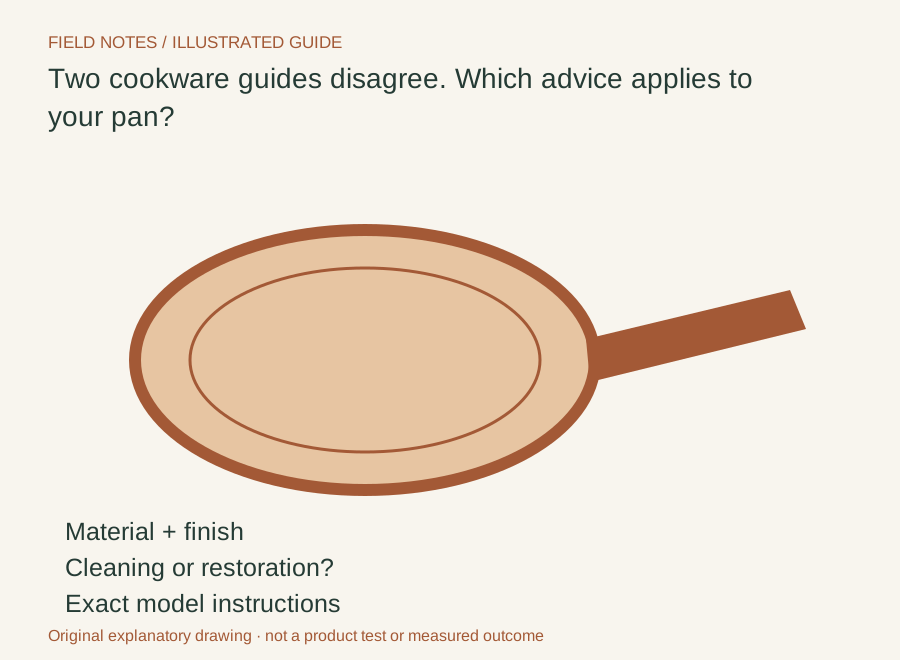
| Can this handle go in the oven? | The exact model’s instructions | The stated limit and any restrictions |
These are selection criteria, not a ranking of the authors. A short care sheet can be more useful than a celebrated book when the question is specific to a handle or coating.
Build a three-column kitchen notebook
Use columns headed instruction, observation and next question. In the instruction column, record what you actually followed, including the edition or web page. In observations, describe the visible result without jumping to a cause. “Food browned near the center first” is more informative than “this is a bad pan.”
The third column keeps the next attempt manageable. You might ask whether the flat cooking base fits your burner, whether you crowded the food, or whether the recipe expected a different pan. Our burner matching guide helps with the first question.
Read the care instructions beside the recipe
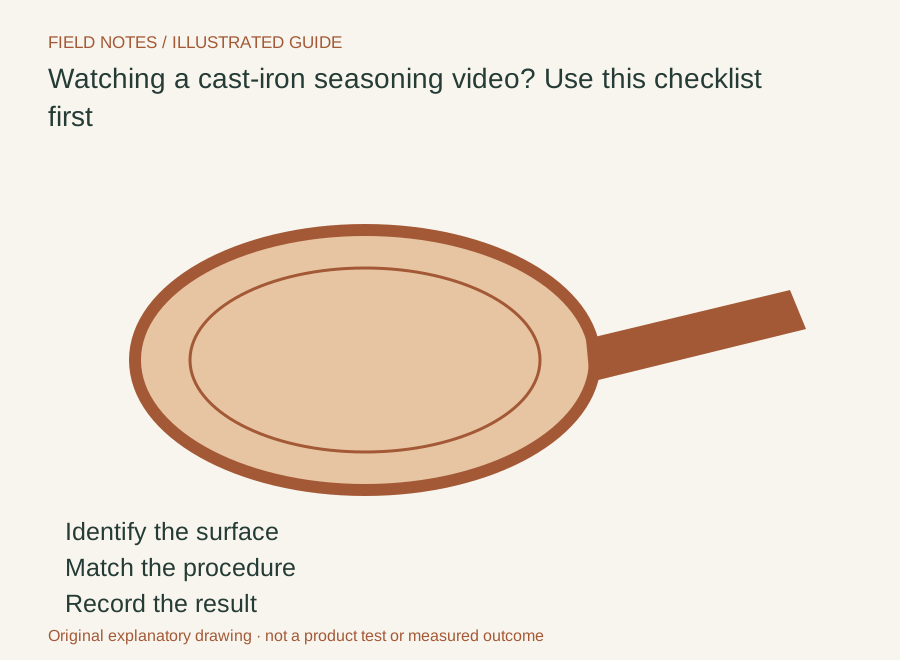
A general recipe does not establish the oven rating of a removable grip. Likewise, a demonstration using bare iron does not explain how to treat damaged enamel. Keep the product identity beside your notes: maker, model, cooking surface and handle material.
Lodge’s cleaning instructions provide a manufacturer example of ordinary care for seasoned cast iron. They are useful within that scope; an unidentified inherited object needs its own assessment.
Give the reading one practical outcome
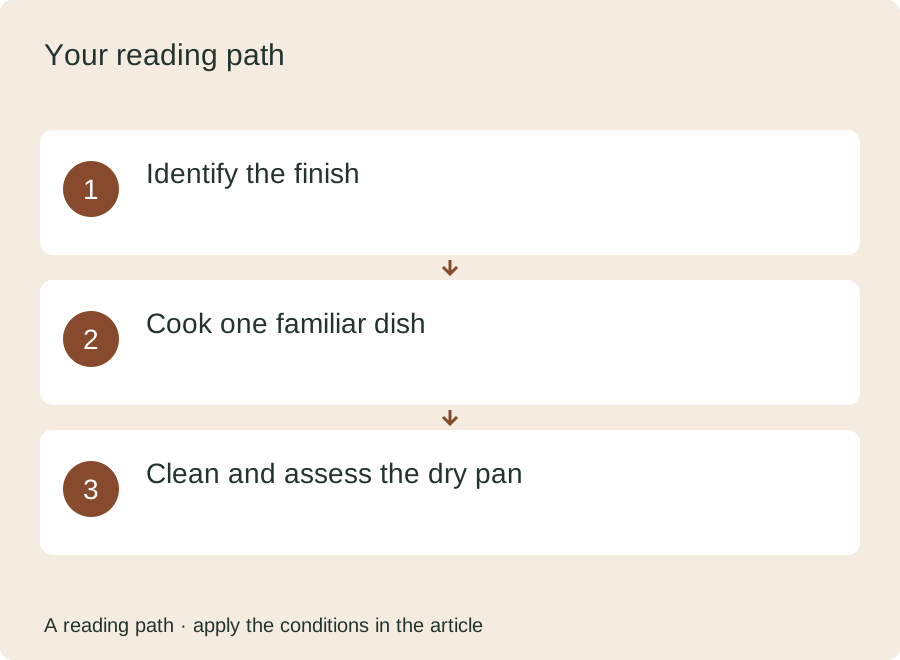
For your first session, choose a familiar dish rather than an expensive ingredient or an elaborate restoration project. Read the full procedure, check that your cookware fits it, and note one result to observe. If the recipe names another diameter, use our pan size calculator to compare areas before changing ingredient amounts.
A good reading session leaves you with a clearer decision. It does not require buying every book or replacing the pans you already own.
Practical check: what to observe
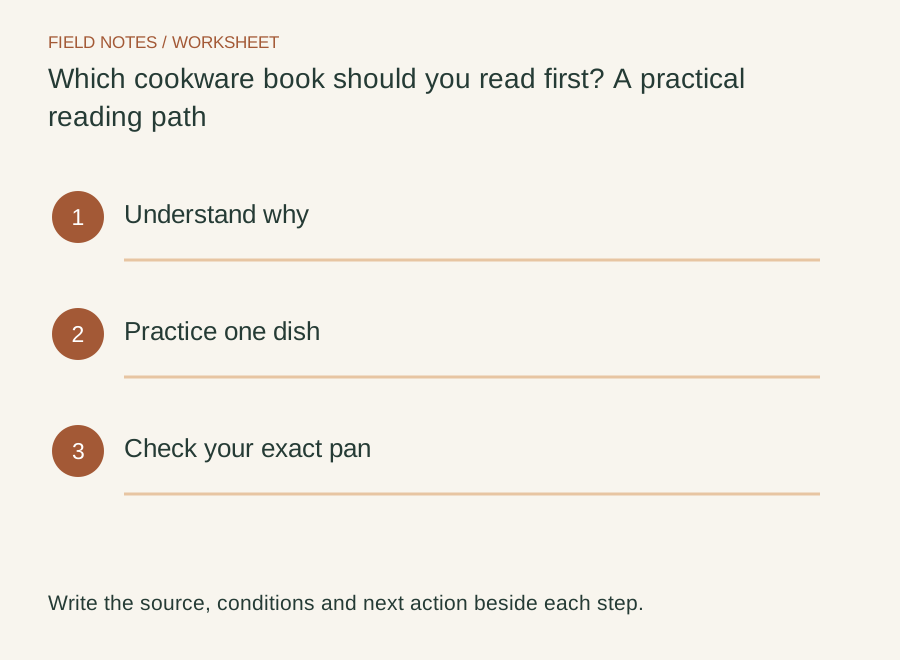
Choose one recurring difficulty and write it at the top of a notebook page. Record the source, the exact pan and one observation from your next meal. Borrowing a book before buying it is a useful way to check whether its format suits your question.
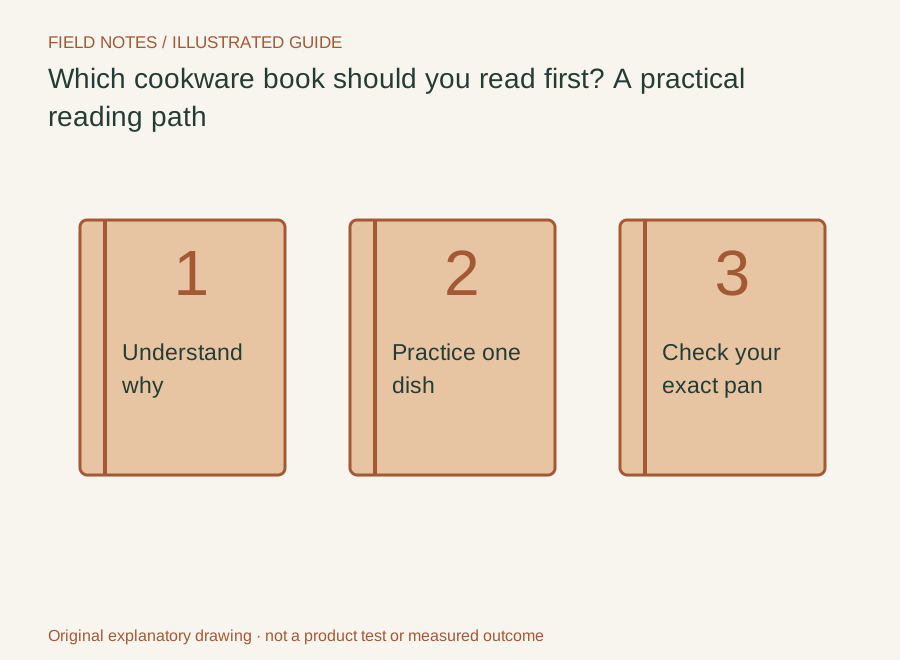
- Understand why
- Practice one dish
- Check your exact pan
Do I need both books before using cast iron?
No. Start with your cookware’s instructions and a suitable recipe. Add a broader reference when you want to understand a recurring result rather than collect more equipment.
For more context, see the topic FAQ and glossary. A reference value or example should be read with its units, assumptions and product-specific conditions.
Sources and scope
The reading below provides context for the relevant care or brewing principles. The article’s scenarios and decision questions are original editorial explanations, not independent product tests. Read the editorial policy for sourcing, AI assistance and corrections.
- Harold McGee — On Food and Cooking
Publisher description used to establish scope; no claim of a complete book review.
- America’s Test Kitchen — Cook It in Cast Iron
Publisher information about recipes, techniques and cast-iron care; not our own recipe testing.
- Lodge — How to Clean Seasoned Cast Iron
Applies to the seasoned cast iron described by this manufacturer; not a universal restoration protocol.
Put the explanation to work
Continue reading
Spot a questionable claim or a calculation issue? Read our correction process and contact information. Examples and illustrations are educational; they do not establish product suitability or a laboratory result.