 SkilletLore
Explainers
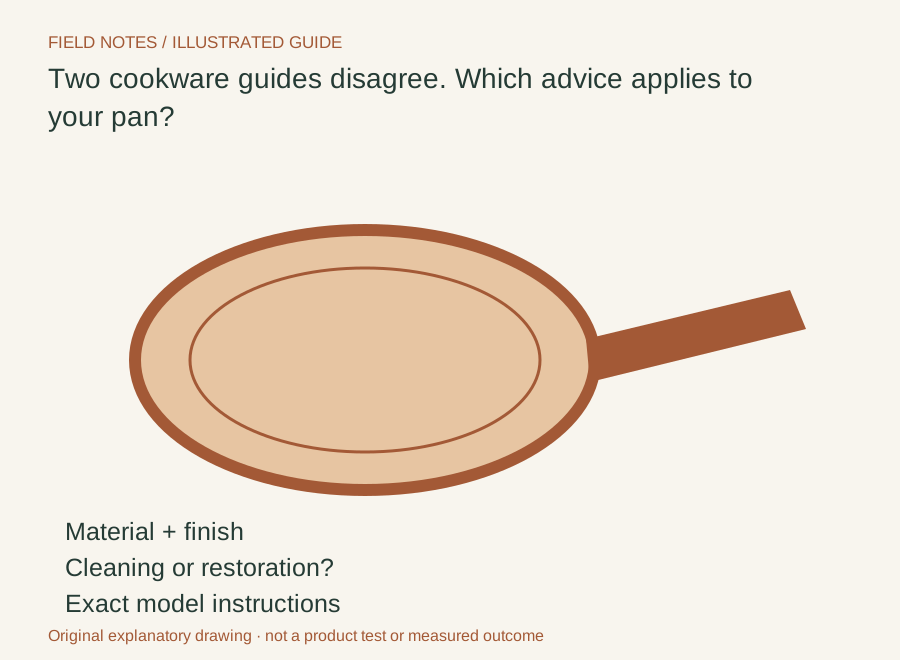
Two cookware guides disagree. Which advice applies to your pan?
Resolve conflicting cookware advice by checking the material, finish, model and task before choosing a care method.

Before you start
When two care instructions conflict, first check whether they describe the same surface and the same job. Routine cleaning, seasoning and removing rust are different tasks. The useful question is which advice applies to this item, not which author wins an argument.
A real example: advice about dish soap
Lodge’s seasoned cast-iron care page permits dish soap. Made In’s carbon-steel guide advises avoiding it for the products discussed there. Those pages do not justify the universal claim that all cookware must—or must never—be washed with soap.
Record the disagreement accurately. They are manufacturer instructions for different product contexts. The next step is to identify your pan and its instructions, rather than treating a short social post as a rule for every cooking surface.
Identify four things before choosing a method
Write down the base material, cooking surface, handle construction and problem. “Black pan” is not enough: a dark interior might be seasoned metal or enamel. A removable grip may have a different heat limit from the body. A layer of cooked-on food calls for a different assessment from a crack.
| Observation | Question to resolve | Useful evidence |
|---|---|---|
| Dark interior | Seasoning or enamel? | Model description and care manual |
| Orange patch | Surface rust or another deposit? | Clean, dry inspection and maker guidance |
| Sticky feel | Food residue or care-product buildup? | Recent cooking and maintenance history |
| Unknown handle | Is the assembled pan oven-safe? | Model-specific temperature restrictions |
If you cannot identify the surface, avoid a destructive experiment intended for a different one. See our surface identification guide for a more focused starting point.
Separate maintenance from repair
An instruction can be sensible for removing rust yet unnecessarily aggressive for washing a pan after dinner. Lodge, for example, distinguishes everyday cleaning tools from abrasive rust-removal methods. Preserve that distinction when taking notes from a video.
Our suggested notebook uses two headings: “after normal cooking” and “only if a diagnosed problem requires it.” Put a source link beside each instruction. This stops a restoration procedure from quietly becoming a daily habit.
Read the boundary around a recommendation
Look for words such as seasoned, enameled, oven-safe, cool, hand-wash and removable. They identify conditions. Also check whether a page is describing the maker’s own product range or making a broader educational claim.
A recipe collection such as Cook It in Cast Iron can supply cooking ideas, but it cannot certify an unidentified handle. Keep the recipe and equipment checks separate.
Send a useful question when the manual is unclear
A concise support question includes the model, a photo of the surface, what happened and what you have already applied. Ask whether the proposed method is suitable for that exact item. “Can I use this on my pan?” is much easier to answer when “this” names a product and method.
Keep any reply with the manual. If you later give the pan to someone else, the record is more useful than a remembered online argument. For an inherited item with uncertain condition, start with our used-skillet inspection guide.

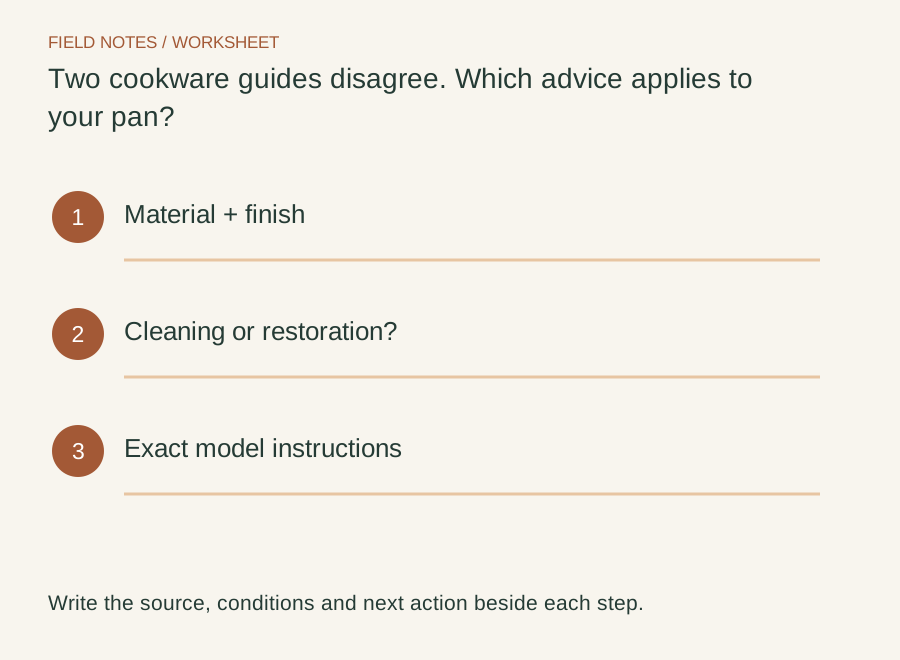
Practical check: what to observe
Photograph the maker’s mark, record the model and save the relevant care page. Separate a normal cleanup question from a restoration question before buying chemicals or abrasive tools.
- Material + finish
- Cleaning or restoration?
- Exact model instructions
Should I combine the strongest steps from several guides?
No. Combining unrelated methods can remove assumptions that made each procedure appropriate. Choose a coherent method for the identified item and task; ask its manufacturer when a restriction is unclear.
For more context, see the topic FAQ and glossary. A reference value or example should be read with its units, assumptions and product-specific conditions.
Sources and scope
The reading below provides context for the relevant care or brewing principles. The article’s scenarios and decision questions are original editorial explanations, not independent product tests. Read the editorial policy for sourcing, AI assistance and corrections.
- Lodge — How to Clean Seasoned Cast Iron
Applies to the seasoned cast iron described by this manufacturer; not a universal restoration protocol.
- Made In — Carbon Steel Care Guide
Product-specific carbon-steel guidance. Brand recommendations are identified as such.
- America’s Test Kitchen — Cook It in Cast Iron
Publisher information about recipes, techniques and cast-iron care; not our own recipe testing.
Put the explanation to work
Continue reading
Spot a questionable claim or a calculation issue? Read our correction process and contact information. Examples and illustrations are educational; they do not establish product suitability or a laboratory result.