 SkilletLore
Perspectives · Embeddable
Inherited skillet: first-month care record
A calm first month beats an emergency restoration: checklist, care-record fields, embed snippet, and what not to do.
In plain language
An inherited skillet care record is a calm first-month checklist for home cooks: identify the finish, clean safely, dry thoroughly, wipe a thin oil film on bare iron if needed, cook simple meals, and store dry—before any emergency strip-and-rebuild of still-usable seasoning.
What this assumes: Bare cast iron or carbon steel at home unless noted; enamel skips oil/seasoning steps. Not a lab protocol and not a reason to invent stronger chemicals.
Before you start
An inherited skillet deserves a care record and a calm first month: clean safely, dry fully, oil thinly when appropriate, heat gently, store dry—and avoid dishwasher cycles, long acid soaks, and wet stacking.
First-month care record checklist
Assumptions: home kitchen, bare seasoned cast iron or carbon steel unless noted, no cracked enamel, no unknown chemical baths. Enamel interiors skip seasoning steps; follow enamel care instead.
- Identify & photograph — Note maker marks, size, cracks, rust vs patina vs food residue. Photograph cooking floor, underside, and handle before changing anything.
- Clean safely — Warm water, soft scrubber, and modern dish soap if needed for food film. Avoid oven cleaner / lye improvisation and long vinegar baths on a first week unless you are following a dedicated restore guide.
- Dry thoroughly — Towel dry, then a brief warm-stovetop dry until no visible moisture remains—especially around the rim and handle junction.
- Thin oil (bare iron / carbon steel) — Wipe a very thin film of a high-smoke-point cooking oil; the surface should look barely sheened, not wet. Skip this on enamel cooking surfaces.
- Gentle heat when needed — If the maker’s care notes call for a light oven or stovetop set after oiling, use that method once—not stacked heavy coats.
- Cook simple, repeatable meals — Prefer fats and moderate heat for early cooks; note sticking, smells, or tackiness in the record.
- Store dry — Cool, dry cupboard or rack; paper towel between stacked pans; lid ajar on Dutch ovens if moisture can trap.
- What NOT to do — Dishwasher; soaking overnight in acid “just to be sure”; steel wool on enamel; putting a soaking-wet pan away; inventing a stronger chemical mix because a forum said so.
Fields worth writing down
- Identity: diameter / volume, marks, estimated era (known / likely / unknown).
- Condition as received: rust spots, sticky film, chips, warping.
- Care applied this month: dates of clean / dry / oil / cook notes.
- Family notes: who used it, what they cooked—labeled as memory, not proven history.
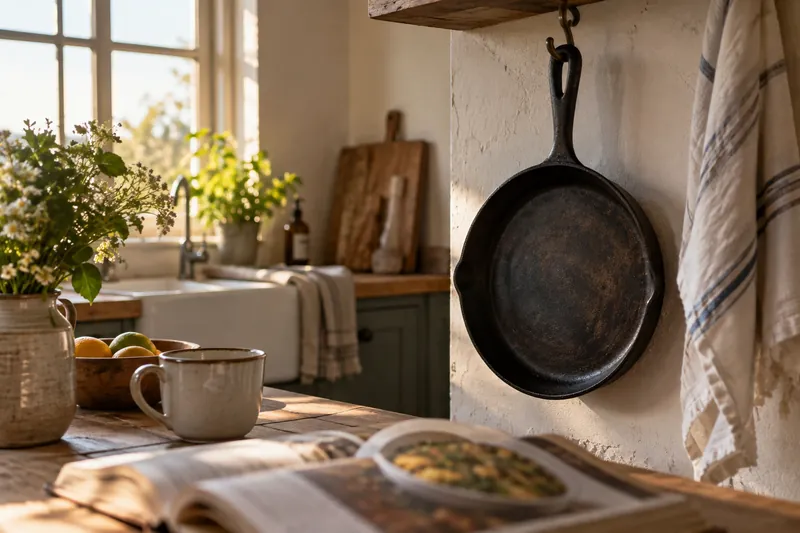
If the pan carries family stories as well as seasoning, a short memoir note about Sunday cooking sits beside the care checklist—HeirloomMath’s memoir writing prompts workflow is built for that kind of keepsake writing.
Embed this checklist
Free to embed with credit and a link back to SkilletLore:
<iframe src="https://skilletlore.com/embed/inherited-skillet-care-record/" title="Inherited skillet first-month care record (SkilletLore)" loading="lazy" style="width:100%;min-height:640px;border:0"></iframe>
<p>Source: <a href="https://skilletlore.com/guides/inherited-skillet-care-record/">SkilletLore inherited skillet care record</a></p>
Minimal page: /embed/inherited-skillet-care-record/. Deeper reading: beginners guide · sticky seasoning · rust vs patina · storage.
What should I do first with an inherited skillet?
Identify the finish, photograph it as received, and start the first-month checklist before stripping or heavy chemistry.
Can I embed this care-record checklist?
Yes—with credit and a link back to SkilletLore via the iframe snippet above.
Should I reseason immediately?
Not automatically. Observe cooking and surface feel for a few weeks unless rust or unsafe damage forces a restore path.
Sources and scope
Educational home-kitchen guidance. It is not a lab protocol and does not authorize unsafe chemical restoration. Read linked hubs for rust, lye, and electrolysis topics framed with manufacturer and safety context. See the editorial policy.
Spot a questionable claim or a calculation issue? Read our correction process and contact information. Examples and illustrations are educational; they do not establish product suitability or a laboratory result.