 SkilletLore
Rust Removal & Chemical Stripping
Electrolysis and cast iron rust removal
A heavily rusted inherited pan is not automatically a good first electrolysis project.
Before you start
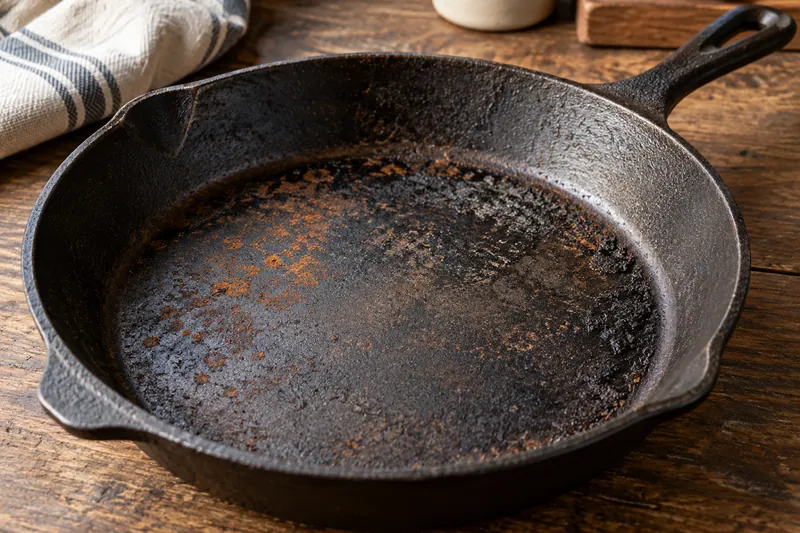
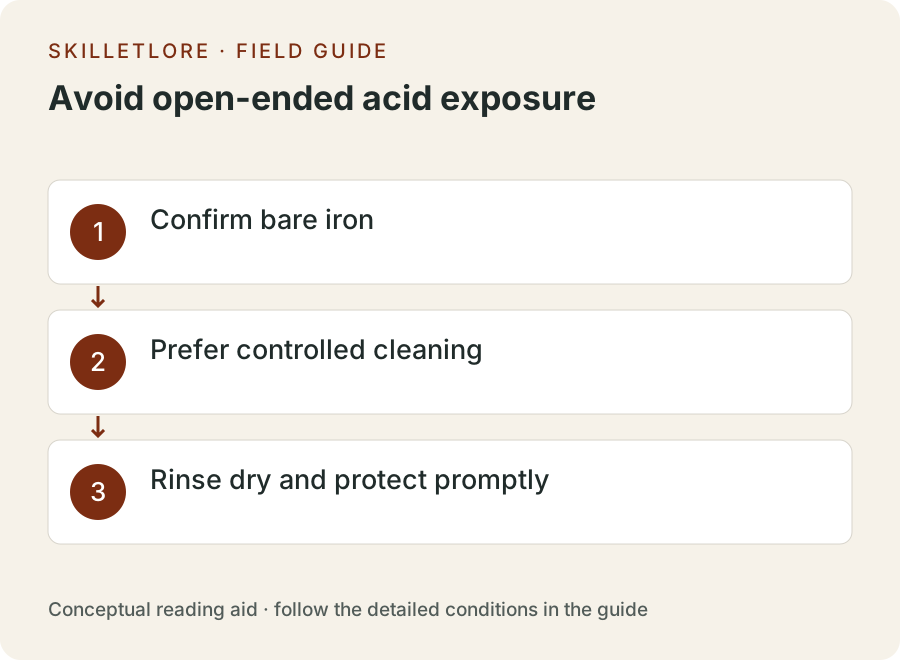
A heavily rusted inherited pan is not automatically a good first electrolysis project. First identify whether the item is bare iron, enamel, plated metal or a mixed-material assembly. Look for cracks and unknown coatings. Preserve identifying marks before removing surface deposits; a photograph may be more useful than an aggressive cleaning attempt.
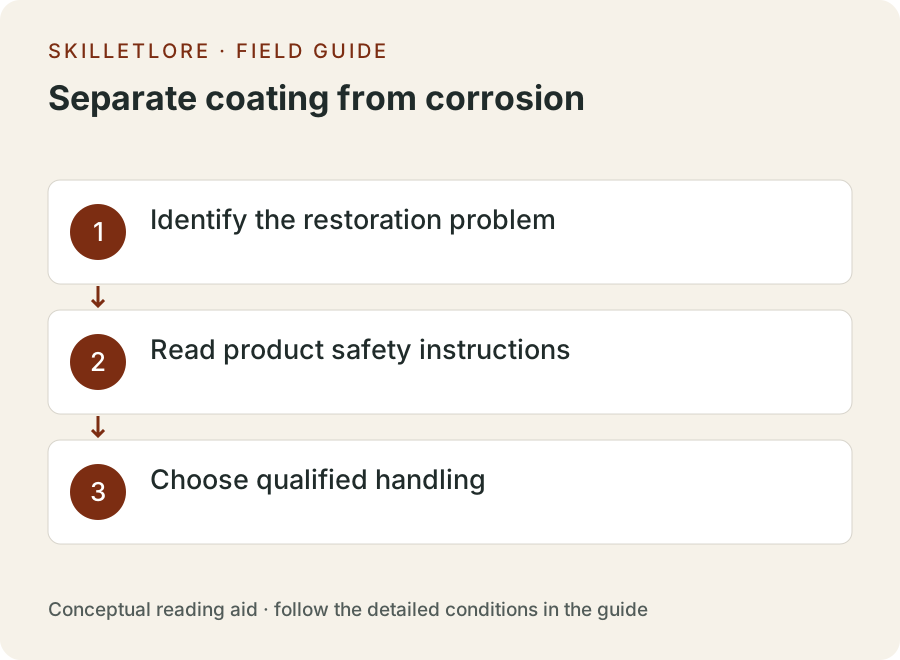
While a sodium hydroxide lye bath (Lye Bath Saponification Guide) dissolves organic polymerized grease, it cannot remove inorganic red rust (Fe₂O₃ · nH₂O and FeO(OH)). Conversely, soaking a rusted skillet in vinegar acid dissolves rust only by simultaneously attacking bare metallic iron (Fe⁰). Low-voltage DC alkaline electrolysis (“e-tank” restoration) is the gold standard of museum iron conservation and vintage cookware restoration because it removes both heavy red rust and stubborn carbonized crud in a single step with zero dissolution of sound metallic iron. You can compare electrolysis against lye and acid treatments across 18 surface failures in our Cast Iron, Carbon Steel & Clad Stainless Defect Diagnostic Matrix.
Electrochemical Mechanism: Cathodic Reduction & Hydrogen Micro-Spalling
An electrolysis tank is an electrolytic cell driven by an external 12V DC power source (a manual automotive battery charger or a regulated 12V–24V, 5A–10A DC bench power supply). Polarity is non-negotiable:
- Cathode (
-Negative Lead, Black Clip): Connected directly to the cast iron skillet being restored. Because electrons are continuously pumped into the skillet, the iron casting is held under cathodic protection and cannot oxidize. - Anode (
+Positive Lead, Red Clip): Connected to sacrificial plain carbon steel plates (or pure high-density graphite sheets) surrounding the skillet. - Electrolyte: Clean tap water mixed with sodium carbonate (
Na₂CO₃, Arm & Hammer Super Washing Soda) at1 tablespoon (~15 g) per US gallon (3.785 L)(~0.037 M,pH ~11.4).
When DC current flows, two simultaneous reactions occur at the surface of the rusted skillet (the cathode):
1. Cathodic Electrochemical Reduction of Red Rust to Black Magnetite:
   3 Fe₂O₃ (insulating red hematite) + H₂O + 2 e⁻  ──>  2 Fe₃O₄ (conductive black magnetite) + 2 OH⁻
   3 FeO(OH) (goethite/lepidocrocite) + e⁻         ──>  Fe₃O₄ (magnetite) + H₂O + OH⁻

2. Cathodic Water Reduction (Hydrogen Gas Evolution):
   2 H₂O + 2 e⁻  ──>  H₂(g)↑ (microscopic bubbles at the metal-scale interface) + 2 OH⁻

3. Anodic Oxidation at the Sacrificial Mild Steel Anode (+):
   Fe⁰ (sacrificial anode)  ──>  Fe²⁺ + 2 e⁻   (and 4 OH⁻ ──> O₂(g)↑ + 2 H₂O + 4 e⁻)
Why does this combination work so cleanly? Red ferric rust (Fe₂O₃) is porous and poorly adherent, whereas reduced magnetite (Fe₃O₄) occupies a smaller molar volume (~44.5 cm³/mol for Fe₃O₄ vs. ~61.6 cm³/mol for 3 FeO(OH)). As bulky red rust converts into denser black Fe₃O₄ crystals, the rust scale shrinks and fractures internally. Simultaneously, nascent hydrogen gas (H₂↑) evolves right at the conductive metallic interface underneath baked-on carbon and rust layers, mechanically prying crud away from the iron without scraping.
Faraday’s Law of Electrolysis: Current, Time, and Mass Reduction
By Faraday’s First Law of Electrolysis, the total electric charge (Q = I × t, in Coulombs) passed through the cell dictates the exact stoichiometric maximum of ferric oxide reduced or hydrogen evolved:
Faraday's Law of Cathodic Reduction:
  n_e = (I × t) ÷ F
  where:
    I = DC current in Amperes (C/s)
    t = time in seconds (hours × 3,600)
    F = Faraday constant = 96,485 C/mol e⁻

Worked Example (5 Amps for 6 Hours):
  Total Charge Q       = 5.0 A × (6 × 3,600 s) = 108,000 Coulombs
  Moles of electrons   = 108,000 C ÷ 96,485 C/mol = 1.119 mol e⁻
  Fe₂O₃ reduced (2e⁻ per 3 Fe₂O₃ = 479.1 g):
    Even if 25% of current goes to Fe₂O₃ reduction and 75% to H₂↑ spalling,
    0.28 mol e⁻ reduces ~67.0 grams of solid ferric rust while generating
    ~9.4 liters of H₂ micro-bubbles directly beneath the skillet crust!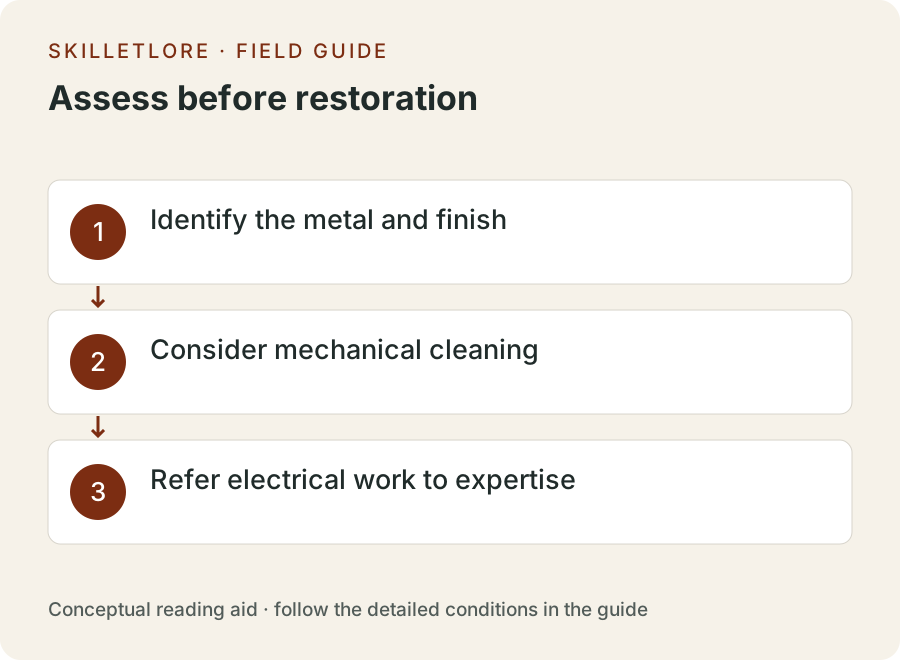
Line-of-Sight Anode Geometry & Electrolyte Conductivity
Because aqueous sodium carbonate electrolyte has a finite electrical conductivity (κ ≈ 6.5 mS/cm at 0.037 M), current density (J = κ · E, in A/dm²) follows the path of least electrical resistance through the water. This creates the line-of-sight rule:
- Single-Side Anode Shadowing: If you hang only one flat steel anode plate facing the bottom of a skillet,
80%of the current lands on the exterior bottom while the interior cooking bowl sits in an electrical “Faraday shadow” and cleans at a fraction of the speed. - Dual-Plate or 360° Anode Cage: Suspend two mild steel anode plates wired in parallel with 10-gauge copper jumper wire—one facing the front cooking surface and one facing the rear heat ring (
2 to 4 inches / 5–10 cmclearance)—or use four vertical rebar/flat-bar strips around the perimeter of a 20-gallon cylindrical trash can. - Why Washing Soda (
Na₂CO₃), Not Table Salt (NaCl) or Baking Soda (NaHCO₃):- Never use table salt (
NaCl): Chloride ions (Cl⁻) oxidize at the anode into toxic chlorine gas (2Cl⁻ → Cl₂↑ + 2e⁻) and promote aggressive halide pitting on iron. - Washing Soda (
Na₂CO₃) vs. Baking Soda (NaHCO₃): Sodium carbonate (Na₂CO₃) dissociates into2Na⁺ + CO₃²⁻atpH 11.4, offering roughly2.5×higher ionic conductivity than sodium bicarbonate (NaHCO₃,pH 8.3). If you only have baking soda on hand, bake it on a sheet pan at400 °F (204 °C)for 45 minutes to thermally decompose it into washing soda (2NaHCO₃ → Na₂CO₃ + H₂O↑ + CO₂↑).
- Never use table salt (
| Anode Material | Suitability | Electrochemical Behavior & Safety Verdict |
|---|---|---|
Plain Mild Carbon Steel (A36 / 1018 sheet or rebar) |
Recommended | Cheap, high surface area; oxidizes into benign Fe(OH)₃ rust sludge that settles to the tank bottom. Needs occasional wire-brushing when crusted over. |
| High-Density Isomolded Graphite Plate | Excellent | Does not form insulating rust scale; evolves O₂ and trace CO₂ while slowly shedding fine carbon dust over hundreds of hours. |
| 304 / 316 Stainless Steel (Sheet, Sinks, Utensils) | STRICTLY FORBIDDEN | Anodic polarization above +0.6 V in alkaline Na₂CO₃ oxidizes trivalent chromium (Cr₂O₃) into soluble yellow hexavalent chromium (CrO₄²⁻, Cr(VI))—a potent human carcinogen and regulated hazardous waste. |
| Copper, Brass, or Galvanized (Zinc-Coated) Steel | Do Not Use | Dissolves Cu²⁺ or Zn²⁺ ions into solution and electroplates a contaminating copper or zinc film onto your cast iron skillet. |
Step-by-Step E-Tank Protocol & Post-Bath Cleanup
- Ventilation & Electrical Setup: Place the plastic tank in an open garage doorway or covered outdoor patio so evolved hydrogen gas (
H₂, lower explosive limit4%in air) dissipates freely. Ensure your12Vbattery charger is a manual (non-smart) unit or use a regulated12V 10ADC bench supply (“smart” microprocessor chargers refuse to turn on when connected to an e-tank because they sense0 Vacross the leads). - Clip Connection (
Unpowered First): With AC power unplugged, clip the BLACK (-) lead firmly to clean metal on the skillet handle, and clip the RED (+) lead to the sacrificial carbon steel anode above the water line. Verify the skillet and anode do not touch (short circuit). Plug in AC power and confirm2 to 8 Ampsof current and fineH₂fizzing rising from the skillet. - Scrubbing Black
Fe₃O₄Sludge: After6 to 12 hours, unplug AC power first, remove the skillet, and scrub under cold running water with a stainless steel pad and Dawn dish soap (Soap vs. Seasoning). A powdery black layer of reduced magnetite (Fe₃O₄) will wash away, revealing clean gray iron. Dry immediately with a towel, warm on low burner heat, and season using our Cooking Oil Smoke Point & Polymerization Matrix.
Practical check: what to observe
Start with the least aggressive maker-approved cleaning suitable for the item. If restoration requires a chemical or electrical process outside your experience, obtain competent guidance. Removing rust does not establish that an unknown historical object is food-safe.
- Identify the metal and finish
- Consider mechanical cleaning
- Refer electrical work to expertise
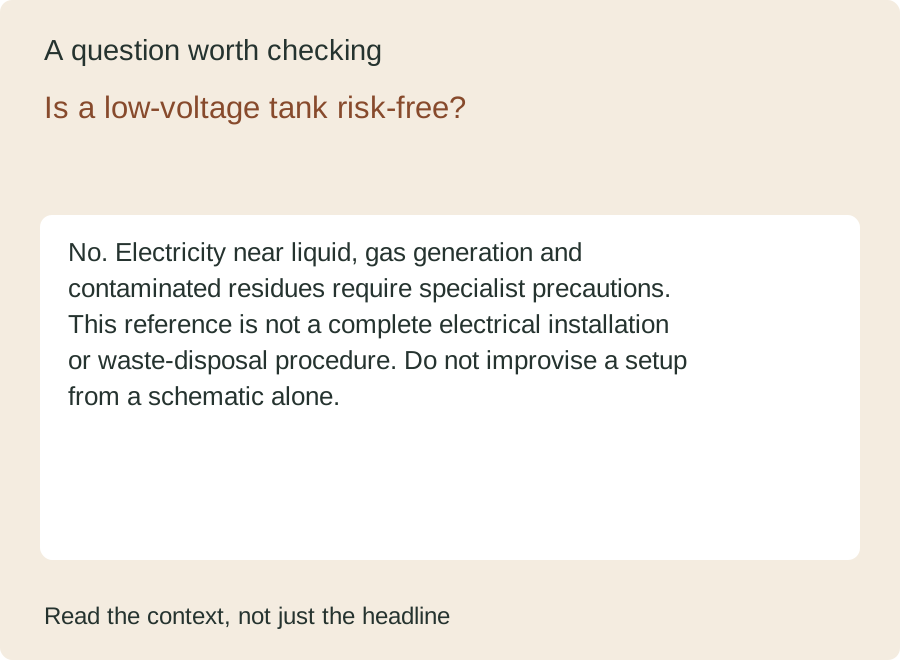
Is a low-voltage tank risk-free?
No. Electricity near liquid, gas generation and contaminated residues require specialist precautions. This reference is not a complete electrical installation or waste-disposal procedure. Do not improvise a setup from a schematic alone.
For more context, see the topic FAQ and glossary. A reference value or example should be read with its units, assumptions and product-specific conditions.
Sources and scope
The references below were supplied with the original manuscript. A reference is not evidence that every numerical claim has been independently checked. See the source library and our verification status.
Put the explanation to work
Continue reading
Spot a questionable claim or a calculation issue? Read our correction process and contact information. Examples and illustrations are educational; they do not establish product suitability or a laboratory result.