 SkilletLore
Oil Polymerization & Seasoning Chemistry
Can you wash cast iron with dish soap?
Ordinary washing and deliberate stripping are different jobs.
Before you start
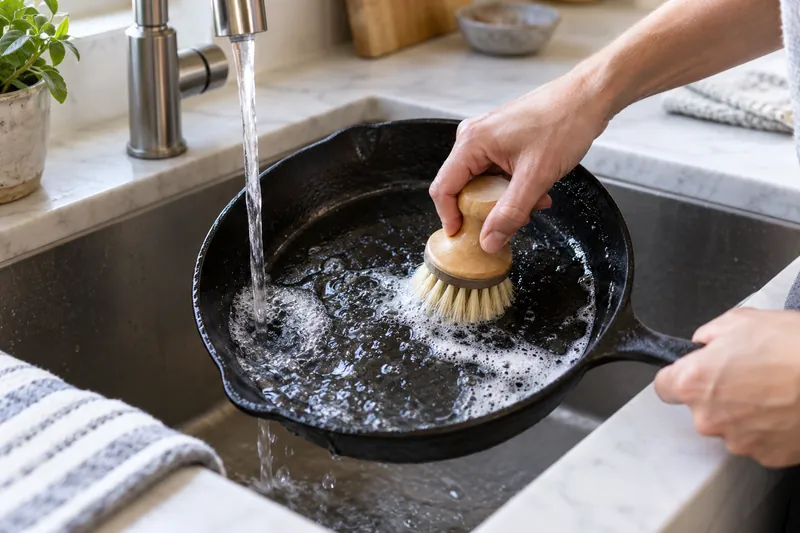
Ordinary washing and deliberate stripping are different jobs. A little dishwashing detergent can remove food and free grease from a seasoned skillet. Long soaking, aggressive abrasion and dishwasher cycles introduce other problems, so avoid treating a soap-versus-no-soap argument as the entire care routine.
No taboo in American kitchen culture is repeated with more conviction than “Never let a drop of dish soap touch a cast iron skillet, or you will strip your grandmother’s seasoning.” This belief leads countless cooks to “clean” fish-, bacon-, or garlic-scented skillets solely by wiping them with coarse salt and a paper towel—leaving a thin film of unpolymerized liquid grease that oxidizes in the cabinet into sticky, rancid aldehydes (hexanal and 2,4-decadienal). From an organic chemistry standpoint, washing a seasoned cast iron or carbon steel skillet with modern liquid dish soap (Dawn, Palmolive, Method, Seventh Generation) is compatible with routine care when used according to the cookware maker’s instructions. If a pan loses black flakes when washed with dish soap, inspect the coating and cleaning method rather than assuming that detergent alone caused the failure. You can diagnose sticky rancid films and black carbon dust in our Cast Iron, Carbon Steel & Clad Stainless Defect Diagnostic Matrix.
Historical True Soap (pH 11–13) vs. Modern Liquid Syndets (pH 7–8)
To understand how the “no soap on cast iron” rule started—and why it became obsolete after the 1940s—we must distinguish between traditional alkali-saponified carboxylate soap containing free caustic lye and modern pH-neutral synthetic surfactants (“syndets”):
1. 19th- and Early 20th-Century Lye Soap (Contains Free NaOH / KOH)
Before commercial synthetic detergents were introduced between 1933 and 1948, household washday soap was boiled from rendered animal tallow or lard mixed with wood-ash potash (K₂CO₃ / KOH) or commercial caustic soda (NaOH). Because homestead and early industrial batch kettle boiling lacked precise potentiometric titration, utility bar and flake soaps deliberately erred on the “lye-heavy” (alkali-excess) side so the soap would not go rancid and could cut heavy axle and kitchen grease.
Washing a skillet in hot water with a lye-heavy bar soap (pH 11.5 to 13.2) exposed the seasoning to free hydroxide ions (OH⁻). As proved in our Lye Bath Saponification Guide, free OH⁻ at pH > 12 executes nucleophilic acyl attack on the glycerol ester hubs (R-COO-CH₂-) of the seasoning network, gradually stripping thin coats of cured oil.
2. Modern Liquid Dish Detergents (pH 6.8 to 8.2, Zero Free NaOH)
Modern hand dishwashing liquids are not alkaline fatty-acid soaps; they are neutral aqueous solutions of synthetic amphiphilic surfactants:
- Sodium Lauryl Sulfate (
SLS,CH₃(CH₂)₁₁OSO₃⁻Na⁺) and Sodium Laureth Sulfate (SLES): Anionic sulfate/ether-sulfate surfactants derived from lauryl alcohol. - Cocamidopropyl Betaine (
CAPB) and Lauramine Oxide: Amphoteric and nonionic foam stabilizers and grease emulsifiers. - Buffered
pH(7.0 to 8.0): Formulated to match human skin neutrality so dishwater does not cause chemical burns on bare hands.
At pH 7.5, the hydroxide ion concentration ([OH⁻] = 3.2 × 10⁻⁷ M) is nearly two million times lower than in a 0.60 M lye bath (pH 13.8). At this neutral pH, the rate constant for base-catalyzed ester saponification of a solid triglyceride polymer is effectively zero.
| Chemical / Physical Property | 1900s Homestead Lye Soap | Modern Liquid Dish Detergent (Syndet) |
Caustic Lye Stripping Bath (NaOH) |
|---|---|---|---|
| Primary Active Species | Sodium tallowate + excess free NaOH / KOH |
SLES, SLS, amine oxide, betaine |
100% Sodium Hydroxide (0.60 M NaOH) |
Aqueous Solution pH |
11.2 to 13.2 (Strongly Alkaline) |
6.8 to 8.2 (Neutral) |
13.8 to 14.0 (Caustic Alkali) |
Hydroxide Concentration [OH⁻] |
1.6 × 10⁻³ to 0.16 mol/L |
1.0 × 10⁻⁷ to 1.6 × 10⁻⁶ mol/L |
0.60 mol/L |
| Emulsifies Liquid Surface Oil? | Yes (via micelles + saponification) | Yes (100% via micellar dispersion) | Yes (converts liquid fat to soap) |
| Cleaves Cured Polymer Bonds? | Yes (slowly over repeated washes) | NO — Physically & chemically impossible | Yes — 100% saponification in 24–48 hr |
| Safe for Bare Human Hands? | Harsh / drying (alkali burn risk) |
Yes — formulated for bare skin | NO — Severe chemical burns |
Thermodynamics of Micelles vs. Covalent Polymer Cross-Links
Why can Dawn dish soap lift liquid bacon grease off a skillet in 5 seconds while leaving polymerized grapeseed or Crisco seasoning completely untouched? Compare the intermolecular vs. intramolecular bond energies involved:
1. Micellar Emulsification of Unpolymerized Liquid Grease (Physical Dispersion):
   • Hydrophobic C12 alkyl tails of SLS/SLES insert into droplets of liquid triglyceride oil
     above the Critical Micelle Concentration (CMC ≈ 0.001–0.008 M).
   • Energy scale: Van der Waals / hydrophobic dispersion forces = 5 to 25 kJ/mol.
   • Result: Free liquid oil droplets are encapsulated inside water-soluble micelles and rinse away.

2. Cured Seasoning Polymer Network (3D Thermoset Macromolecule):
   • Cross-linked via covalent C–O–C ether bonds (358 kJ/mol), C–C bonds (347 kJ/mol),
     and glycerol ester bonds (~360 kJ/mol) anchored across millions of repeating units;
     see Polymerization Chemistry Guide.
   • Energy gap: Surfactant micelles lack the chemical activation energy (~350 kJ/mol) or
     nucleophilic [OH⁻] concentration required to break covalent C–C, C–O–C, or ester bonds!
Simply put, asking neutral dish soap to dissolve cured cast iron seasoning is like asking dish soap to dissolve a hardwood cutting board, an oil-based alkyd house paint, or a PVC pipe. Once liquid monomer oil has cross-linked into a solid macromolecular polymer network, it is no longer “oil”—it is a solid plastic-like resin.
“Wait—Why Did My Pan Look Dull or Shed Black Specks After Using Soap?”
When a cook washes a skillet with dish soap and notices either (a) black flecks rinsing down the drain or (b) the shiny black floor turning matte gray-black, one of two things happened:
- You Washed Off Unpolymerized Liquid Oil + Loose Carbon Char: A skillet that looks glossy right after frying bacon is shiny only because it is wet with liquid fat. Washing away that unpolymerized grease reveals the true matte-satin appearance of the cured polymer underneath. Similarly, black specks that rinse off with a nylon brush are loose carbonized food char (
Maillard/pyrolysis residue), not bonded seasoning. Leaving that char on the pan actually blocks fresh oil from bonding to the iron and causes future food to stick. - Wait-for-It Dishwasher Mistake (Automatic Dishwasher Packs ARE Alkaline!): While hand dish soap (
Dawn) ispH 7–8, automatic dishwasher pods and powders (Cascade,Finish) are formulated atpH 10.5 to 12.5with sodium carbonate, sodium metasilicate, and sodium percarbonate bleach, paired with a90-minute 150 °F (65 °C)spray cycle and a humid heated dry cycle. Running cast iron through an automatic dishwasher will hydrolyze seasoning and cover the pan in orange flash rust.
The Optimal 90-Second Post-Cook Cleaning Routine
To keep cast iron and carbon steel completely odor-free, smooth as glass, and rust-proof:
- Let the Pan Cool Slightly (
~150–180 °F): Never plunge a screaming-hot500 °Fcast iron skillet into cold sink water (thermal shock can crack gray iron or warp carbon steel). Let it cool for 3–5 minutes until warm to the touch. - Scrub with Hot Water, 2 Drops of Dish Soap & Chainmail: Add warm water, two drops of liquid syndet dish soap, and glide a 316 stainless steel ring-mesh chainmail scrubber or stiff nylon brush over any stuck fond. The rounded rings knock off carbonized food bumps without scratching the cured polymer film.
- Rinse, Stove-Dry (
60 Seconds), and Optional 2-Drop Buff: Rinse clean, towel dry, set the skillet on a low burner for60 secondsto evaporate moisture from the handle joint and rim, and—if the pan looks dry or will be stored in a humid climate—wipe 2 drops (<0.2 mL) of refined grapeseed or canola oil (Oil Smoke Point & Polymerization Matrix) across the warm floor with a paper towel.
Practical check: what to observe
Check the pan when it is dry rather than judging through a layer of water or oil. A persistent sticky surface suggests excess residue that needs attention. Do not leave a damp pan stacked beneath other cookware while deciding whether the finish looks perfect.
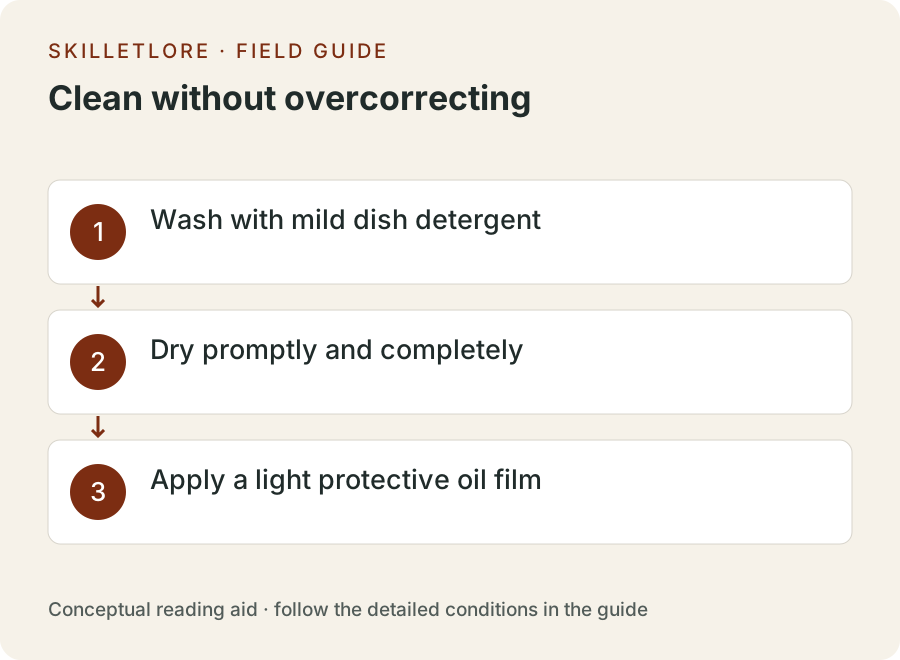
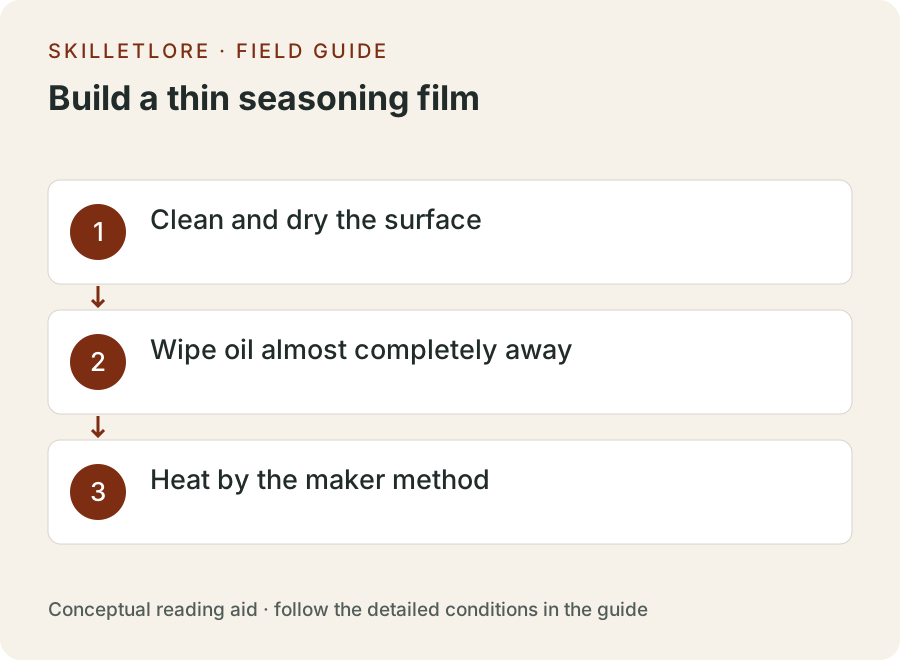
- Wash with mild dish detergent
- Dry promptly and completely
- Apply a light protective oil film
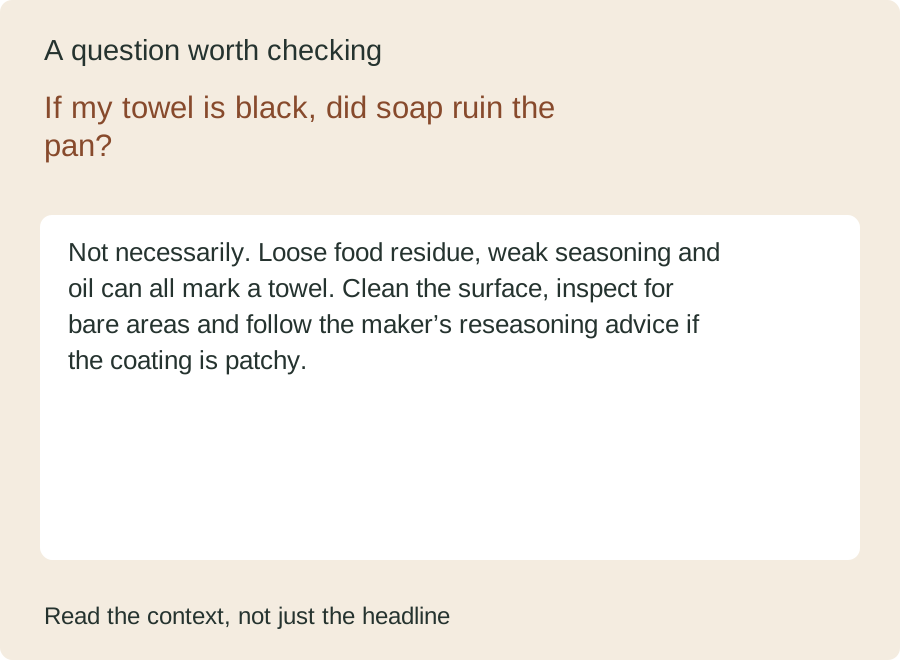
If my towel is black, did soap ruin the pan?
Not necessarily. Loose food residue, weak seasoning and oil can all mark a towel. Clean the surface, inspect for bare areas and follow the maker’s reseasoning advice if the coating is patchy.
For more context, see the topic FAQ and glossary. A reference value or example should be read with its units, assumptions and product-specific conditions.
Sources and scope
The references below were supplied with the original manuscript. A reference is not evidence that every numerical claim has been independently checked. See the source library and our verification status.
- Ullmann's Encyclopedia of Industrial Chemistry – Laundry and Dishwashing Detergents (Syndet Formulations)
- Journal of Surfactants and Detergents – Micellar Solubilization of Liquid Triglycerides vs. Cross-Linked Alkyd Films
- Lodge Cast Iron Official Cleaning Guidelines – Using Mild Dishwashing Soap on Seasoned Iron
Put the explanation to work
Continue reading
Spot a questionable claim or a calculation issue? Read our correction process and contact information. Examples and illustrations are educational; they do not establish product suitability or a laboratory result.