 SkilletLore
Oil Polymerization & Seasoning Chemistry
Seasoning oil: iodine value vs smoke point
A high smoke point answers a different question from an oil’s unsaturation.
Before you start
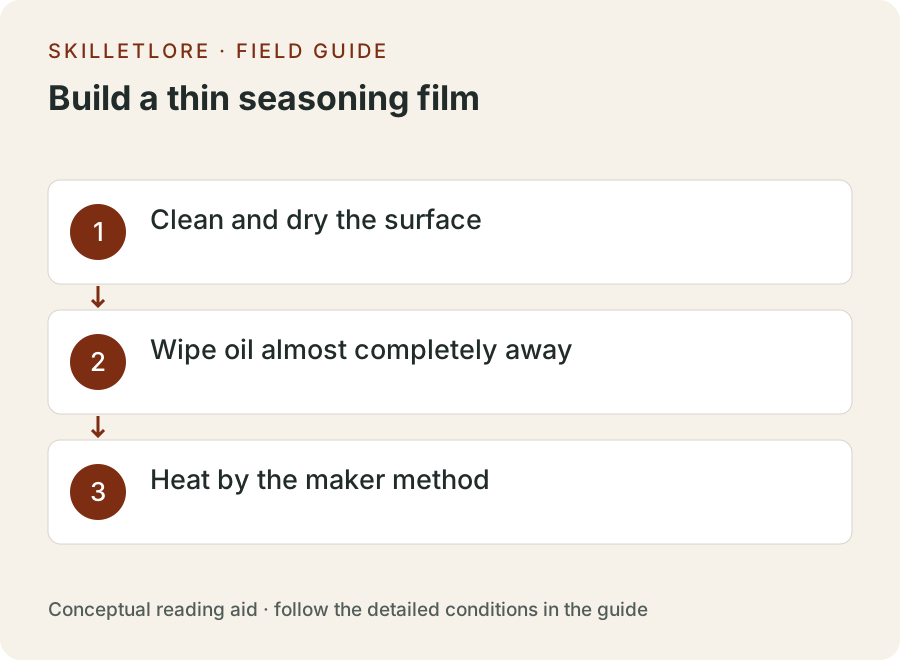
A high smoke point answers a different question from an oil’s unsaturation. Neither number predicts the adhesion of a seasoning layer on its own. Film thickness, surface preparation, heating and repeated use all influence whether it feels tacky or flakes. Start with a readily available oil recommended by the cookware maker.
For over a decade, thousands of home cooks have meticulously stripped vintage skillets, applied six oven-baked coats of expensive organic cold-pressed flaxseed oil, admired the glossy jet-black mirror finish—and then watched in frustration as black flakes peeled off into their third batch of seared steaks or scrambled eggs. Meanwhile, a $20 diner skillet seasoned with ordinary soybean oil, canola oil, or Crisco shortening endures thousands of commercial burner cycles without a single chip. Solving this paradox requires separating Smoke Point from Wijs Iodine Value (IV) and analyzing the polymer mechanics of cross-link density versus elastic elongation. You can filter all 22 culinary fats by both parameters in our Cooking Oil Smoke Point & Polymerization Matrix.
Why Smoke Point Alone Misleads Cookware Restorers
When cooks shop for a seasoning oil, they frequently sort oils by smoke point, assuming that a 520 °F (271 °C) refined avocado oil must create a stronger polymer than a 400 °F (204 °C) canola oil or 360 °F (182 °C) vegetable shortening. In lipid chemistry, smoke point is an impurity metric, not a polymerization metric:
- Free Fatty Acid (
FFA) Volatility: Unrefined cold-pressed oils contain0.5% to 2.5%unattached free fatty acids (R-COOH), phospholipids, and volatile phytosterols that vaporize between225 °F and 375 °F. Industrial alkali neutralization (NaOHwash) and vacuum steam deodorization strip free fatty acids below0.05%, boosting the smoke point by70 to 120 °Fwithout changing the triglyceride’s double-bond structure. - The Refined Avocado Oil Trap: Refined avocado oil has a
520 °Fsmoke point because itsFFAcontent is near zero, not because it cross-links well. Its fatty acid profile is~70%monounsaturated oleic acid (C18:1) and only~13%polyunsaturated linoleic/linolenic acid (Wijs IV ≈ 85). Baked in a standard home oven at425–450 °F, refined avocado oil lacks both the thermal energy and the bis-allylic radical sites (272 kJ/mol; see Polymerization Chemistry: How Drying Oils Bond to Raw Iron) to form a dense network, leaving a soft or tacky film.
Wijs Iodine Value (g I₂ / 100g) and the C18:3 / C18:2 Ratio
Under AOCS Official Method Cd 1d-92, the Iodine Value (IV) quantifies the grams of iodine monochloride (ICl, expressed as I₂ equivalents) that react by electrophilic addition across the carbon-carbon double bonds (C=C) in 100 grams of fat. Because each fatty acid chain contributes proportionally to the total double-bond count, we can compute the theoretical iodine value directly from an oil’s gas-chromatography fatty acid profile:
Theoretical Iodine Value from Fatty Acid Mass Fractions:
  IV ≈ (0.860 × % Oleic C18:1) + (1.732 × % Linoleic C18:2) + (2.616 × % Alpha-Linolenic C18:3)

Worked Comparison:
  • Flaxseed Oil (18% C18:1, 16% C18:2, 54% C18:3):
    IV ≈ (0.860 × 18) + (1.732 × 16) + (2.616 × 54) = 15.5 + 27.7 + 141.3 = 184.5 g I₂/100g

  • Grapeseed Oil (17% C18:1, 69% C18:2, 1% C18:3):
    IV ≈ (0.860 × 17) + (1.732 × 69) + (2.616 × 1)  = 14.6 + 119.5 + 2.6  = 136.7 g I₂/100g

  • Canola Oil (62% C18:1, 19% C18:2, 9% C18:3):
    IV ≈ (0.860 × 62) + (1.732 × 19) + (2.616 × 9)  = 53.3 + 32.9 + 23.5  = 109.7 g I₂/100g
Notice the crucial structural difference between alpha-linolenic acid (C18:3, 3 double bonds, 2 bis-allylic carbons at C11 and C14) and linoleic acid (C18:2, 2 double bonds, 1 bis-allylic carbon at C11):
| Seasoning Fat | Smoke Point (°F) |
Wijs IV |
Saturated (%) |
Oleic C18:1 (%) |
Linoleic C18:2 (%) |
Linolenic C18:3 (%) |
Thermal Cycling Durability |
|---|---|---|---|---|---|---|---|
| Flaxseed (Unrefined) | 225 °F |
182 |
10% |
18% |
16% |
54% |
Poor — brittle flaking after 5–15 high-heat cycles |
| Grapeseed (Refined) | 420 °F |
134 |
11% |
17% |
69% |
1% |
Excellent — hard linoleic network with low shrinkage |
| Soybean / Veg Oil | 450 °F |
130 |
15% |
23% |
54% |
7% |
Excellent — commercial foundry pre-seasoning standard |
| Corn Oil (Refined) | 450 °F |
125 |
13% |
28% |
54% |
1% |
Excellent — balanced hardness and impact toughness |
| Canola (Refined) | 400 °F |
114 |
7% |
62% |
19% |
9% |
Excellent — high oleic plasticizer prevents shear cracks |
| Crisco Shortening | 360 °F |
102 |
29% |
35% |
32% |
4% |
Superior — solid paste wipes ultra-thin (<2 µm) |
| Refined Avocado | 520 °F |
85 |
12% |
70% |
12% |
1% |
Moderate — requires 500 °F+ to avoid tacky gum |
| Refined Coconut | 400 °F |
9 |
91% |
7% |
2% |
0% |
Fails — cannot cross-link into a polymer network |
Three Polymer-Mechanics Reasons Why Flaxseed Oil Delaminates
When flaxseed oil was promoted as an “industrial-strength” cast iron seasoning in 2010, the argument relied on its use as fine-art oil paint binder and linoleum floor cement. However, oil paintings and linoleum cure at ambient 20–25 °C on substrates that never experience 500 °F (260 °C) gas burners. On iron cookware, flaxseed’s 54% alpha-linolenic acid content triggers three mechanical failure modes:
1. Excessive Cross-Link Density (ν_e) and High Glass Transition (T_g)
Because every C18:3 chain possesses two reactive bis-allylic centers (C11 and C14), a flaxseed triglyceride carrying two or three linolenic chains can form 4 to 6 covalent bridges to neighboring molecules. According to rubber-elasticity and thermoset polymer theory, the shear modulus (G) rises linearly with cross-link density (ν_e), while elongation at break (ε_max) plummets. With only 18% oleic acid (C18:1) to serve as a flexible internal plasticizer, cured flaxseed film behaves like brittle thermoset glass rather than tough elastomer-toughened enamel.
2. Oxidative Chain Scission and Volumetric Cure Shrinkage
During a 450–500 °F bake, the terminal double bond at C15–C16 in alpha-linolenic acid undergoes rapid beta-scission, splitting off volatile 3-carbon and 6-carbon aldehydes (propanal, acrolein, 2,4-heptadienal). Losing 12% to 18% of the initial organic mass after the film has already gelled creates tensile shrinkage stress (σ_shrink) locked inside the coating before you even cook on the pan.
3. Interfacial Thermal Expansion Shear (Δα)
When you place a skillet on an induction coil or gas burner, the gray cast iron floor expands at α_iron ≈ 10.8 × 10⁻⁶ K⁻¹, while the organic polymer film expands at α_poly ≈ 65–90 × 10⁻⁶ K⁻¹. In a six-coat flaxseed build (total thickness d ≈ 15–25 µm), the interfacial shear energy (G_s ∝ d · E · (Δα · ΔT)²) exceeds the adhesive bond strength to smooth metal—especially on polished vintage Griswold or stamped French carbon steel skillets—causing whole patches to spall off like fingernail polish.
How to Fix a Flaking Flaxseed-Seasoned Skillet
If your skillet is shedding black specks into food, consult our Cast Iron & Carbon Steel Defect Diagnostic Matrix and follow one of two recovery paths:
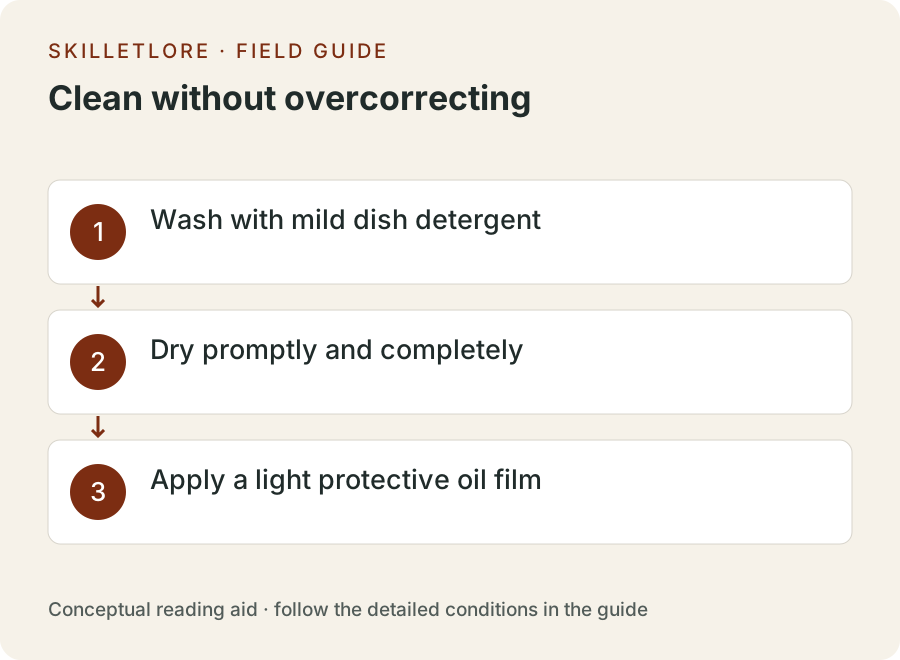
- Partial Mechanical Feathering (Minor Flaking): Scrub the warm skillet vigorously with a 316 stainless chainmail scrubber and liquid syndet dish soap (Soap vs. Seasoning Chemistry) until every loose or undermined edge is removed. Dry on low burner heat and apply two micro-thin oven coats of grapeseed oil (
IV 134) or Crisco (IV 102) at450 °F (232 °C)for 60 minutes. - Complete Chemical Reset (Widespread Delamination): If baking new coats over remaining flaxseed continues to peel because the bottom boundary layer is fractured, strip the pan down to bare gray iron in a room-temperature sodium hydroxide bath (Lye Bath Saponification Guide) and rebuild from scratch with a semi-drying fat.
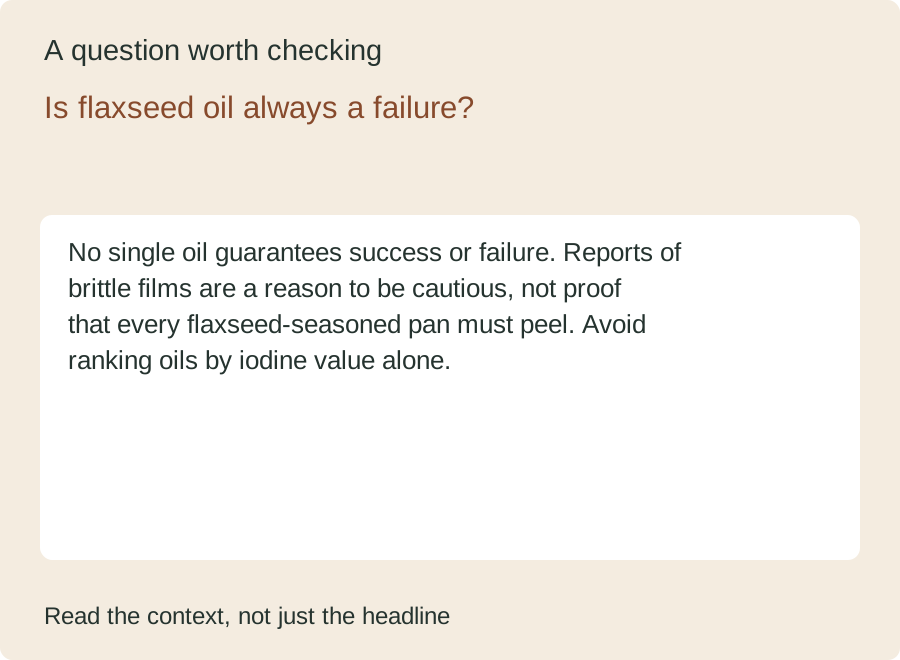
Practical check: what to observe
If you compare oils, use comparable surfaces and record the number of coats and the amount wiped away. Evaluate ordinary cooking and cleaning over time. A shiny finish on the day of seasoning is not an adhesion or durability test.
- Separate smoke from curing
- Apply a very thin coat
- Evaluate the cooled film
Is flaxseed oil always a failure?
No single oil guarantees success or failure. Reports of brittle films are a reason to be cautious, not proof that every flaxseed-seasoned pan must peel. Avoid ranking oils by iodine value alone.
For more context, see the topic FAQ and glossary. A reference value or example should be read with its units, assumptions and product-specific conditions.
Sources and scope
The references below were supplied with the original manuscript. A reference is not evidence that every numerical claim has been independently checked. See the source library and our verification status.
- AOCS Official Method Cd 1d-92 – Iodine Value of Fats and Oils (Cyclohexane-Acetic Acid Wijs Method)
- USDA FoodData Central – Fatty Acid Composition of Culinary Vegetable Oils and Animal Fats
- Polymer Degradation and Stability – Cross-Link Density and Glass Transition Temperature in Linseed vs. Safflower Alkyd Films
Put the explanation to work
Continue reading
Spot a questionable claim or a calculation issue? Read our correction process and contact information. Examples and illustrations are educational; they do not establish product suitability or a laboratory result.