 SkilletLore
Oil Polymerization & Seasoning Chemistry
How cast iron seasoning forms
The useful distinction is between a cured surface film and excess liquid oil.
Before you start
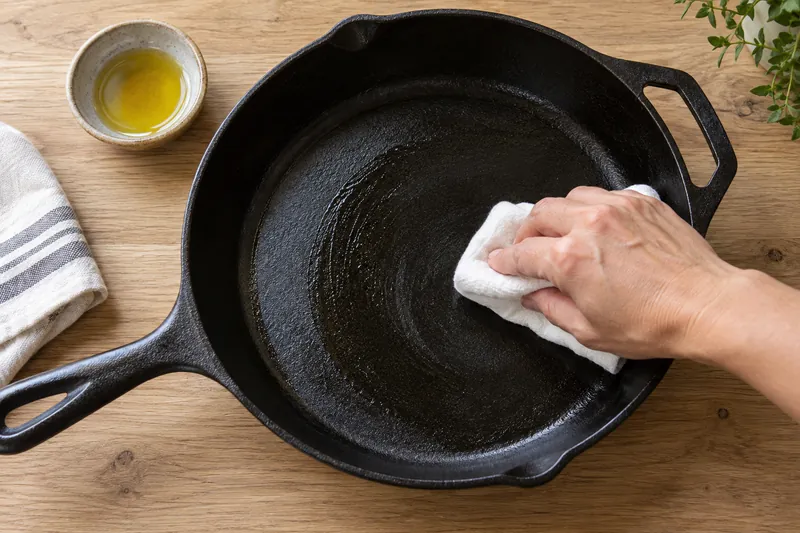
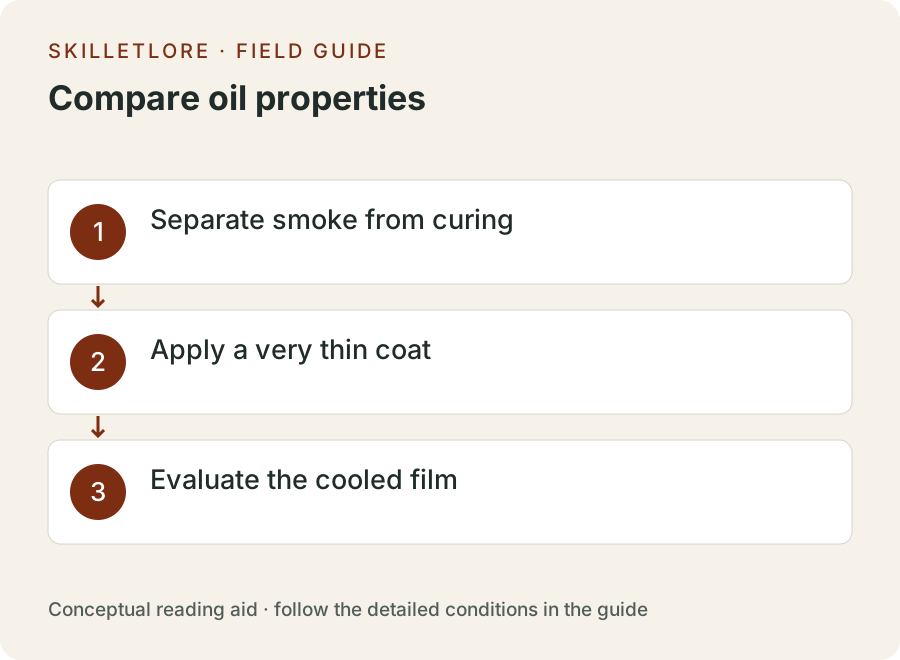
The useful distinction is between a cured surface film and excess liquid oil. After applying oil, wipe until the pan looks nearly dry. Pools around lettering, handle joints or the rim are places where an uneven layer can remain. More oil does not necessarily produce more useful protection in one cycle.
Every popular guide to cast iron care begins with a persistent piece of kitchen mythology: that heating a skillet “opens the microscopic pores of the iron” so liquid oil can seep inside before the pores “close as the pan cools.” From a metallurgical standpoint, solid gray cast iron (ASTM A48 Class 20–30) and stamped low-carbon steel (AISI 1010–1020) are crystalline metals, not biological skin. They do not possess pores that dilate and constrict. Instead, cookware seasoning is an in-situ thermally cured organic polymer coating—chemically identical to an industrial alkyd enamel—anchored to an iron oxide substrate. You can compare the exact fatty acid profiles and cross-linking potentials of 22 culinary fats in our Cooking Oil Smoke Point & Polymerization Matrix.
Surface Topography vs. “Metal Pores”: What Actually Holds Seasoning
When molten gray iron solidifies in a sand mold at a foundry, ~2.8% to 3.5% carbon precipitates out as interconnected lamellar graphite flakes embedded within a matrix of alpha-ferrite and pearlite. When the casting is tumbled with steel shot or stone-ground (as seen on vintage skillets; see Identifying Vintage Griswold, Wagner, and Lodge Casting Marks), the surface exhibits a measurable arithmetic average roughness (R_a) ranging from 1.2 µm on vintage ground skillets to 8.5–12.0 µm on modern sand-cast pans.
When you heat cast iron from room temperature (20 °C) to oven curing temperature (232 °C / 450 °F), the metal undergoes isotropic linear thermal expansion governed by its coefficient of thermal expansion (α_L ≈ 10.8 × 10⁻⁶ K⁻¹):
Linear Thermal Expansion Across a 250 mm (10-inch) Skillet Floor:
  ΔL = L₀ × α_L × ΔT
  ΔL = 250 mm × (10.8 × 10⁻⁶ K⁻¹) × (232 - 20) K = 0.572 mm (0.23% expansion)
Both the peaks (asperities) and valleys of the machined surface expand proportionally by 0.23%; nothing pinches shut upon cooling. Why, then, does warming a pan to 150–200 °F (65–93 °C) before wiping on oil improve seasoning? Because the kinematic viscosity (ν) and surface tension (γ) of liquid triglycerides drop sharply with temperature. Warm oil wets microscopic crevices (R_a valleys) completely instead of beading over trapped air pockets, maximizing physical contact area before free-radical cross-linking begins.
The Four Stages of Free-Radical Triglyceride Polymerization
A culinary fat molecule is a triacylglycerol consisting of a three-carbon glycerol backbone esterified to three 16- or 18-carbon fatty acid chains. Transforming this liquid oil into a solvent-insoluble, hydrophobic solid requires linking adjacent triglyceride molecules into a three-dimensional macromolecular network across four chemical stages:
Stage 1: Initiation (Bis-Allylic Hydrogen Abstraction)
Polyunsaturated fatty acids such as linoleic acid (C18:2 Δ9,12) and alpha-linolenic acid (C18:3 Δ9,12,15) contain 1,4-pentadiene systems (-CH=CH-CH₂-CH=CH-). The central methylene carbon (-CH₂- at C11 or C14) is flanked by two double bonds. While breaking an ordinary saturated C–H bond requires 410 kJ/mol, the bis-allylic C–H bond dissociation energy is only 272 kJ/mol (65 kcal/mol) because the resulting pentadienyl radical (L•) delocalizes its unpaired electron across five carbon atoms:
1. Initiation (Thermal + Trace Peroxide / Metal-Assisted H-Abstraction):
   L-H (bis-allylic methylene)  ──[Heat ≥ 180°C / Fe³⁺]──>  L• (pentadienyl radical) + H•
   (Rearranges rapidly into a conjugated diene system: -CH=CH-CH=CH-CH•-)
Stage 2: Propagation (Oxygen Capture and Hydroperoxide Formation)
Atmospheric triplet dioxygen (³O₂) is a diradical that reacts at near-diffusion-controlled rates (k ≈ 10⁸ M⁻¹s⁻¹) with carbon-centered pentadienyl radicals (L•) to form a lipid peroxyl radical (LOO•). That peroxyl radical then abstracts a bis-allylic hydrogen atom from a neighboring triglyceride chain (L'-H), propagating the radical chain reaction and forming a lipid hydroperoxide (LOOH):
2. Propagation (Peroxyl Radical Chain):
   L• + O₂          ──>  LOO• (lipid peroxyl radical)
   LOO• + L'-H      ──>  LOOH (lipid hydroperoxide) + L'• (new pentadienyl radical)
This step explains why film thickness is the critical failure variable. Oxygen must diffuse from the oven air through the oil film to feed propagation. If you apply a thick puddle of oil (> 15–25 µm), the top skin oxidizes and skins over, starving the underlying liquid oil of O₂ and leaving a soft, sticky amber gum that never cures (compare this failure mode in our Cookware Defect Diagnostic Atlas). Buffing the oiled skillet with a dry paper towel until it looks completely dry leaves an ultra-thin film (1 to 3 µm) where oxygen permeates the entire depth instantly.
Stage 3: Iron-Catalyzed Branching (Redox Hydroperoxide Cleavage)
Why does the same cooking oil cure much faster on cast iron or blued carbon steel than on glass or aluminum? Bare and lightly oxidized iron surfaces are covered in wüstite (FeO), magnetite (Fe₃O₄, containing both Fe²⁺ and Fe³⁺), and hematite (Fe₂O₃). In industrial paint chemistry, iron, cobalt, and manganese carboxylates are added as primary “siccatives” (driers) because Fe²⁺ / Fe³⁺ redox couples catalyze the homolytic cleavage of hydroperoxides (LOOH) into highly reactive alkoxyl radicals (LO•) and peroxyl radicals (LOO•), lowering the activation energy of cross-linking from ~105 kJ/mol to ~50 kJ/mol:
3. Iron-Oxide Redox Branching (Surface Catalysis):
   LOOH + Fe²⁺ (surface magnetite)  ──>  LO• (alkoxyl radical) + OH⁻ + Fe³⁺
   LOOH + Fe³⁺ (surface oxide)      ──>  LOO• (peroxyl radical) + H⁺ + Fe²⁺
Furthermore, free carboxylic acid groups generated during minor ester hydrolysis form iron carboxylate coordination bonds (-COO⁻ ··· Fe²⁺/Fe³⁺) directly with the magnetite lattice (see Carbon Steel Bluing: Magnetite Passivation Before First Seasoning), chemically tethering the base polymer layer to the pan.
Stage 4: Termination (3D Covalent Cross-Linking vs. Beta-Scission)
As the concentration of carbon-centered (L•), alkoxyl (LO•), and peroxyl (LOO•) radicals peaks at 400–475 °F (204–246 °C), pairs of radicals collide and terminate into permanent covalent bridges linking separate triglyceride molecules into an insoluble 3D polymer network:
4. Termination (Cross-Linked Network Formation):
   L•  + L•   ──>  L–L       (Carbon-Carbon bridge, highest thermal stability)
   L•  + LO•  ──>  L–O–L     (Ether bridge, flexible & alkali-resistant)
LO• + LO• ──> L–O–O–L (Peroxy bridge, rearranges thermally at >220°C)| Chemical Species / Bond | Typical Bond Energy | Role in Skillet Seasoning Matrix |
|---|---|---|
Bis-allylic C–H (C18:2 / C18:3) |
272 kJ/mol |
Primary radical initiation site; governs drying rate (IV > 100). |
Mono-allylic C–H (C18:1 Oleic) |
322 kJ/mol |
Secondary cross-linking site + internal flexible plasticizer chain. |
Saturated C–H (C16:0 / C18:0) |
410 kJ/mol |
Chemically inert during normal baking; excess causes non-drying grease. |
Ether Cross-Link (C–O–C) |
358 kJ/mol |
Primary elastic covalent bridge connecting adjacent triglycerides. |
Carbon-Carbon Cross-Link (C–C) |
347 kJ/mol |
Non-hydrolyzable backbone bond immune to soap and mild food acids. |
Ester Linkage (-COO- to Glycerol) |
~360 kJ/mol |
Vulnerable only to strong alkali (NaOH pH 14 lye saponification). |
Thermal Pyrolysis and Carbon Reinforcement (450–500 °F)
Alongside radical cross-linking, baking near or slightly above an oil’s smoke point triggers partial beta-scission (cleaving volatile aldehydes like hexanal and acrolein, which you smell in the oven) and partial thermal pyrolysis. This embeds microscopic domains of amorphous sp² carbon inside the flexible alkyd polymer matrix—turning the golden-amber first coat into the classic satin-black composite finish of well-seasoned iron.
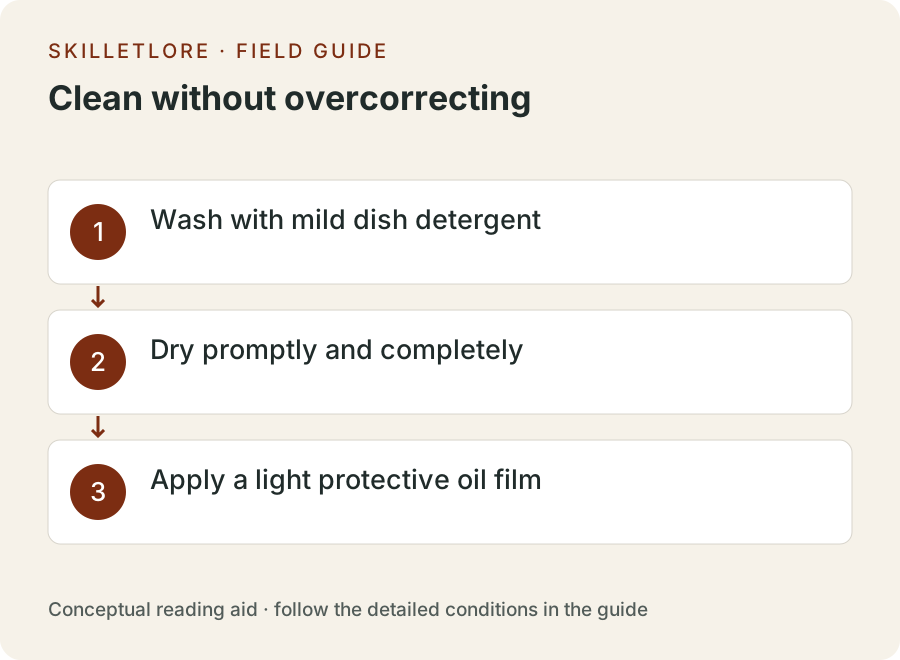
To understand why oils with excessive triple-unsaturated chains over-crosslink and peel, read Iodine Value vs. Smoke Point: Why Flaxseed Oil Flakes on Skillets, and see why ordinary dish detergent cannot cleave these C–O–C and C–C bridges in Soap vs. Seasoning: Why Modern Syndet Dish Soap Cannot Strip Polymerized Oil.
Practical check: what to observe
After the pan cools, assess tackiness and loose residue before adding another coat. Record the oil and heating method if you are troubleshooting. A kitchen observation supports a practical adjustment; it does not prove a particular molecular network or measured coating thickness.
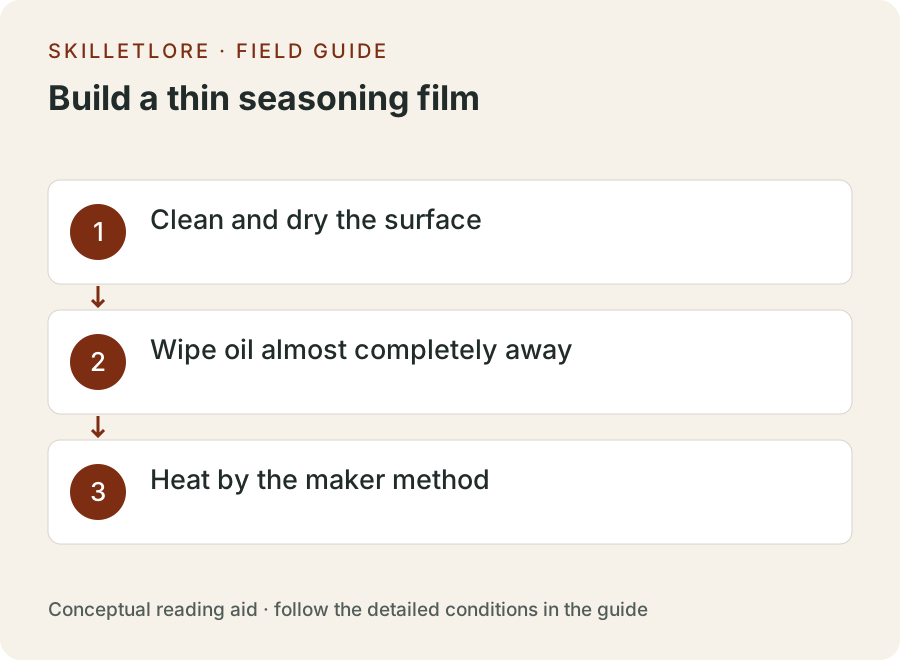
- Clean and dry the surface
- Wipe oil almost completely away
- Heat by the maker method
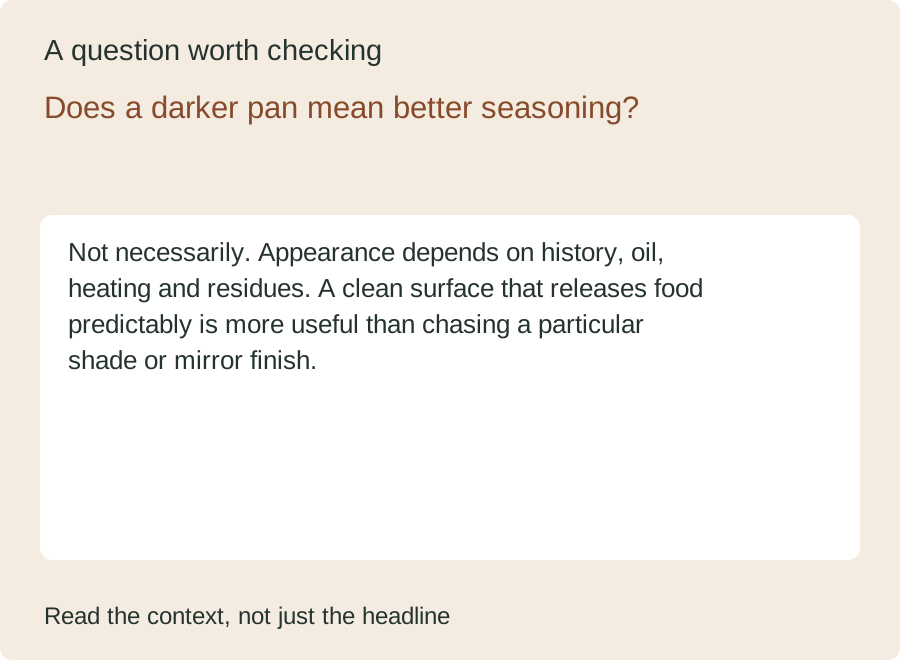
Does a darker pan mean better seasoning?
Not necessarily. Appearance depends on history, oil, heating and residues. A clean surface that releases food predictably is more useful than chasing a particular shade or mirror finish.
For more context, see the topic FAQ and glossary. A reference value or example should be read with its units, assumptions and product-specific conditions.
Sources and scope
The references below were supplied with the original manuscript. A reference is not evidence that every numerical claim has been independently checked. See the source library and our verification status.
- AOCS Lipid Library – Lipid Oxidation and Radical Cross-Linking Pathways
- Progress in Organic Coatings – Autoxidation and Drying Mechanisms of Triglyceride Alkyd Resins
- Journal of the American Oil Chemists' Society – Transition Metal Catalysis in Lipid Peroxidation
- ASTM A48 / A48M – Standard Specification for Gray Iron Castings
Put the explanation to work
Continue reading
Spot a questionable claim or a calculation issue? Read our correction process and contact information. Examples and illustrations are educational; they do not establish product suitability or a laboratory result.