 SkilletLore
Vintage Identification & Enamel Care
Identify vintage cast iron without guesswork
An unmarked skillet may resemble several makers’ patterns.
Before you start
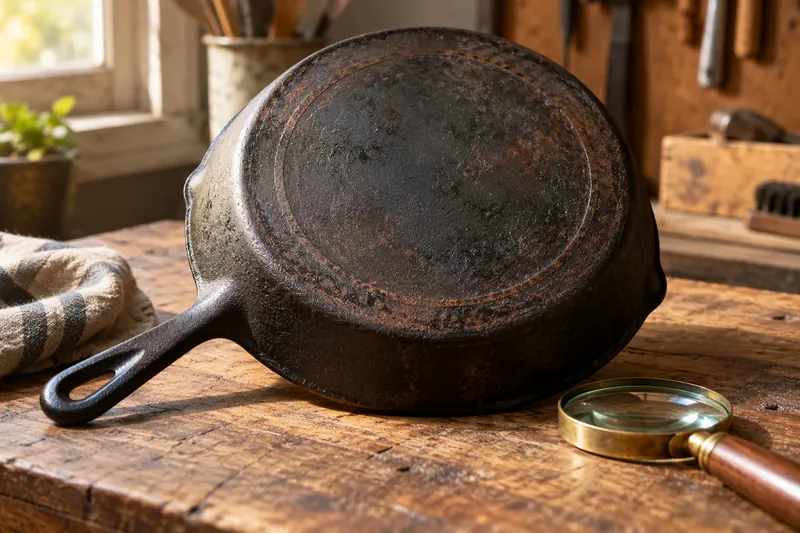
An unmarked skillet may resemble several makers’ patterns. A heat ring or a single numeral is a clue, not a complete attribution. Record the handle underside, pour spouts, overall dimensions, casting texture and every mark before comparing reference photographs. Keep uncertainty visible in any sale or collection description.
When you lift a encrusted 1920s skillet out of a sodium hydroxide bath (Lye Bath Saponification Guide) or a 12V electrolysis tank (Electrolysis Tank Rust Removal), the newly revealed underside tells an exact industrial story. Even if a pan carries no brand name at all, its heat-ring geometry, underside handle profile, pour spout width, and incised pattern numerals identify which American foundry poured it and within which decade between 1880 and 1965. You can diagnose vintage surface defects such as sulfur coal-ash pitting and warped “spinner” bottoms in our Cast Iron, Carbon Steel & Clad Stainless Defect Diagnostic Matrix.
Why Vintage Castings Feel Lighter and Smoother Than Modern Iron
Why does a vintage #8 (10.5-inch) Griswold or Wagner skillet weigh 3.6 to 4.1 lbs (1.65–1.85 kg) with a satin-smooth floor, whereas a modern #8 skillet weighs 5.2 to 5.5 lbs (2.35–2.50 kg) with a pebble-textured floor? The shift was driven by automated foundry molding machines, not “higher quality iron ore”:
- Hand-Rammed Green Sand & Thin Walls (
1880s–1950s): Skilled molders hand-rammed fine-grained Albany molding sand (AFS Grain Fineness 90–120) into horizontal flasks (cope and drag), pouring high-fluidity phosphorus-bearing gray iron into walls as thin as2.0–2.5 mm. Afterward, machinists mounted each cooled skillet in a rotary lathe jig and stone-ground (milledorpolished) the interior floor and rim, leaving concentric spiral swirl marks (R_a ≈ 1.2–2.0 µm). - Automated High-Pressure Vertical Molding (
1950s–1960s): To survive rising labor costs and competition from stamped aluminum and Teflon, foundries adopted high-speed automated sand-molding lines (such as vertical flasklessDISAMATICsystems). Ejecting hot castings rapidly from automated molds without cracking required thicker walls (3.5–4.2 mm) and coarser sand permeability, and most foundries phased out manual stone-grinding by the mid-1960s.
Foundry 1: Griswold Manufacturing Co. (Erie, Pennsylvania, 1865–1957)
Founded by Matthew Griswold in Erie, Pennsylvania (and closed after corporate acquisition in December 1957), Griswold castings are prized for featherweight walls, generous pour spouts, and crisp pattern numbers (for example, 704 on a standard #8 skillet).
| Griswold Era / Trademark | Production Years | Center Logo & Bottom Geometry | Handle & Pattern Mark Details |
|---|---|---|---|
"ERIE" Skillets (1st–6th Series) |
c. 1880 – 1907 |
"ERIE" in quotation marks at 12 o’clock; outside or inset heat ring; no circle-cross logo yet. |
Thin reinforced lip handle; early series lack pattern numbers; later series show 700-series number at 6 o’clock. |
Slant Logo (“ERIE” vs. “ERIE, PA.”) |
c. 1906 – 1929 |
Circle-cross emblem with italicized GRISWOLD'S ERIE (1906–1912) or GRISWOLD with "ERIE" (1909–1916, inset heat ring) or "ERIE, PA., U.S.A." (1916–1929, smooth bottom option). |
Teardrop hanging hole with tapered flat underside rib reaching the sidewall. |
Large Block Logo (Heat Ring & Smooth) |
c. 1920 – 1940 |
Large ~3.2-inch circle-cross emblem in upright block letters; ERIE, PA., U.S.A. below; heat ring (1920–1930) or smooth bottom (1930–1940). |
Classic teardrop hole; size numeral incised on top of handle (#2 through #14). |
Small Block Logo (3 Handle Styles) |
c. 1939 – 1957 |
Compact ~1.75-inch circle-cross logo + ERIE PA. below; smooth bottom. |
Chronological handle shift: Early (1939–44) rounded hole; Late (1944–57) pointy teardrop hole; Grooved (1950–57) recessed thumb groove on underside. |
Iron Mountain (Unmarked Griswold) |
c. 1935 – 1946 |
No brand name; distinctive 4-digit pattern number (1031 to 1039) in bold block font at 6 o’clock; inset heat ring. |
Unique triangular elongated hanging hole; full Griswold stone-ground interior. |
Foundry 2: Wagner Manufacturing Co. (Sidney, Ohio, 1891–1959)
Founded by brothers Bernard and Milton Wagner in Sidney, Ohio (after acquiring Sidney Hollow Ware in 1897), Wagner pioneered smooth-bottom skillets in 1935 as wood/coal cookstoves with round burner eyes gave way to gas grates and flat electric coils.
- Early Arc Logo (
1891–1915):"WAGNER"or"WAGNER SIDNEY O."stamped in a curved arc across12 o’clockwith an outside heat ring (a raised rim flush with the outer edge of the base). - Stylized Script Logo + Outside Heat Ring (
1915–1935): The famous underlined scriptWagner Ware Sidney -O-paired with an outside or inset heat ring and a4-digitcatalog number (1053to1064, where1058 = #8) at6 o’clock. - Stylized Script Logo + Smooth Bottom (
1935–1959): Identical script logo on a completely flat bottom without a heat ring; triangular flattened rib under the handle. - Unmarked Wagner (
1935–1969): Stamped at6 o’clockin clean sans-serif letters with the exact diameter description—e.g.,10 1/2 INCH SKILLET. If"MADE IN USA"appears below the inch description, the pan was cast after 1960 (under Textron/Randall corporate ownership, often alongside dual Wagner Ware / Griswold logos cast in Sidney, OH after the Erie plant closed).
Foundry 3: Lodge (South Pittsburg, Tennessee, 1896–Present) & Unmarked Fingerprints
Because Lodge cast millions of unmarked skillets for department stores before introducing its modern egg-in-skillet logo in 1987 (and factory vegetable-oil pre-seasoning in 2002), collectors date vintage Lodge by notches cut into the inset heat ring:
| Unmarked Foundry / Series | Production Era | Heat-Ring & Underside Identification Fingerprints |
|---|---|---|
No-Notch Lodge ("Blacklock" Era & Early Lodge) |
c. 1900 – 1930 |
Continuous unbroken inset heat ring; raised size number on top of handle (1900–1920) or large incised size number at 12 o’clock (1910–1930). |
Single-Notch Lodge |
c. 1930 – 1940 |
Inset heat ring broken by one notch at 12 o’clock; large incised size numeral at 12 o’clock + small raised molder’s mark letter at 6 o’clock. |
Three-Notch Lodge (Early vs. Late) |
c. 1940 – 1987 |
Inset heat ring broken by three notches at 9, 12, and 3 o’clock. Pre-1960: Size number only at 12 o’clock. Post-1960: Adds "SK" (Skillet) and "MADE IN USA" near center/6 o’clock. |
BSR (Birmingham Stove & Range, AL) |
c. 1930 – 1992 |
Unbroken inset heat ring + sharp, knife-like ridge running all the way under the handle to a small round hole. Red Mountain (1930s–50s): Hand-scribed size + letter (8 A) at 6 o’clock. Century (1950s–92): Stamped "NO. 8 — 10 5/8 IN.". |
Gate-Marked 19th-Century Skillets |
c. 1840 – 1895 |
Raised linear scar (1.5 to 3 inches long, the bottom gate mark where molten iron entered the mold) running across the center of the bottom; often stands on three small legs or a high heat ring. |
Before restoring any newly acquired vintage casting, check for warping (flatness on a granite countertop) and inspect for gray solder residue (lead contamination disclaimer), then strip old crust using a Sodium Hydroxide Lye Bath and season with our Cooking Oil Smoke Point & Polymerization Matrix.
Practical check: what to observe
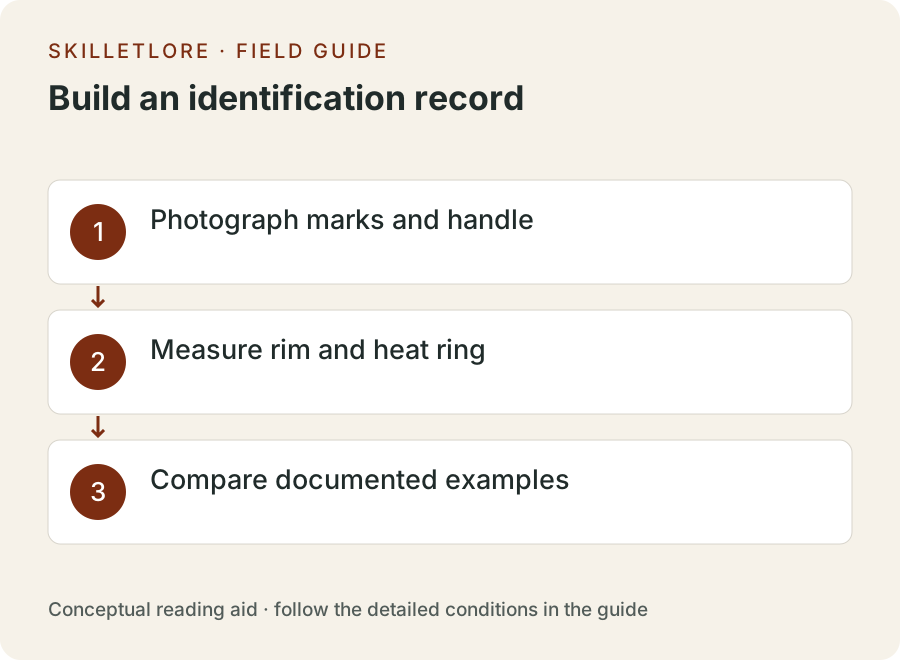
Use diffuse side lighting and a ruler in the same plane as the feature. Save uncropped originals. Avoid sanding a mark to make it clearer, because irreversible surface changes can remove evidence that later identification depends on.
- Photograph marks and handle
- Measure rim and heat ring
- Compare documented examples
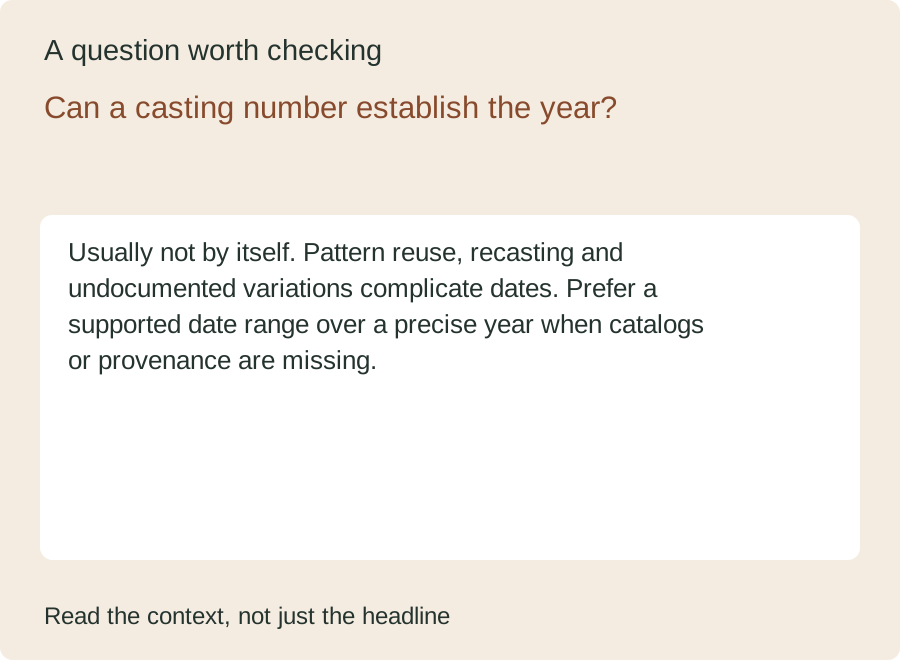
Can a casting number establish the year?
Usually not by itself. Pattern reuse, recasting and undocumented variations complicate dates. Prefer a supported date range over a precise year when catalogs or provenance are missing.
For more context, see the topic FAQ and glossary. A reference value or example should be read with its units, assumptions and product-specific conditions.
Sources and scope
The references below were supplied with the original manuscript. A reference is not evidence that every numerical claim has been independently checked. See the source library and our verification status.
- The Book of Griswold & Wagner: Favorite, Wapak, Sidney Hollow Ware (David G. Smith & Chuck Wafford, Schiffer Publishing)
- The Cast Iron Collector – Foundry Trademarks, Unmarked Iron, and Skillet Size Charts
- Hagley Museum and Library – Historic American Foundry Patternmaking and Automated DISAMATIC Molding
Put the explanation to work
Continue reading

Spot a questionable claim or a calculation issue? Read our correction process and contact information. Examples and illustrations are educational; they do not establish product suitability or a laboratory result.