 SkilletLore
Vintage Identification & Enamel Care
Enameled cast iron: cracks, chips and care
A dark utensil mark, a fine surface line and a missing fragment of enamel can look similar in a photograph.
Before you start
A dark utensil mark, a fine surface line and a missing fragment of enamel can look similar in a photograph. Clean gently using the maker’s approved method, dry the surface and inspect under consistent light. Avoid probing a suspected chip with a metal tool, which can worsen the damage.
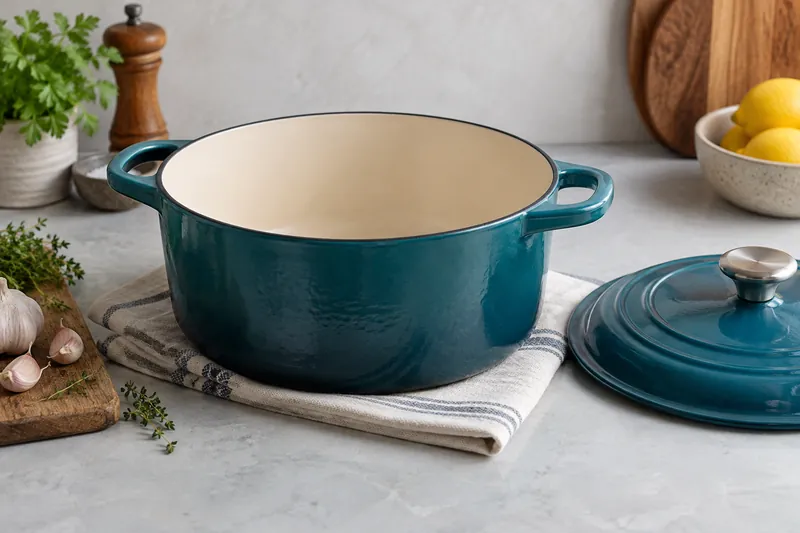
Enameled cast iron Dutch ovens and skillets (Le Creuset, Staub, Chasseur, Lodge Enamel) combine the high volumetric heat capacity of gray cast iron with a chemically inert vitreous porcelain glass surface that can simmer acidic tomato ragùs and wine braises for hours without leaching iron (Acidic Foods in Cast Iron Guide). However, because porcelain enamel is a true brittle silicate glass fused to a metallic casting, treating an enameled Dutch oven like raw cast iron—by preheating it empty on a high induction coil, plunging it hot into a sink of cold water, or striking the rim with metal spoons—triggers two distinct ceramic fracture modes: tensile crazing and compressive/impact spalling (chipping). You can compare crazing, chipping, and matte-black enamel fouling in our Cast Iron, Carbon Steel & Clad Stainless Defect Diagnostic Matrix.
Materials Science of Vitreous Enamel on Gray Cast Iron
Manufacturing an enameled cast iron pot requires spraying finely ground borosilicate glass frit (SiO₂, B₂O₃, Na₂O, K₂O, TiO₂ opacifiers, and cobalt/nickel adherence oxides) onto a shot-blasted gray iron casting and firing it in a kiln at 780 °C to 840 °C (1,436 °F to 1,544 °F):
- The Ground Coat (
0.15–0.25 mm, Dark Blue-Black): Contains cobalt (CoO) and nickel (NiO) oxides that promote chemical interdiffusion with iron oxides at the casting boundary, plus prevents carbon monoxide gas bubbles from the cast iron’s graphite flakes from blistering the top coat. (This dark ground coat is also what forms the exposed matte black rim on every enameled pot!) - The Cover Coat (
0.50–1.10 mm, Glossy Cream/Sand or Satin Black): Either a titanium-dioxide opacified light glaze (Le Creusetsand interior, allowing easy visual monitoring of fond browning) or a slightly rougher, higher-firing matte black glass glaze (Staubcocottes andLe Creusetskillets). Crucial reminder: A matte black interior on an enameled skillet is 100% glass, NOT bare cast iron—never put it in a lye tank or attempt to strip it with steel wool!
Coefficient of Thermal Expansion (CTE) Mismatch: Compression vs. Tension
Like all glass, vitreous porcelain enamel is 10 times stronger under compression (~700–900 MPa) than under tension (~60–85 MPa). Ceramic engineers exploit this asymmetry by formulating the enamel glass with a slightly lower linear coefficient of thermal expansion (α_enamel ≈ 8.8 to 9.6 × 10⁻⁶ K⁻¹) than the gray cast iron substrate (α_iron ≈ 10.8 × 10⁻⁶ K⁻¹).
When the pot cools from its 520 °C glass set-point down to room temperature (20 °C), the iron casting shrinks more than the glass shell, locking the enamel layer into protective residual compressive stress (σ_res ≈ -80 to -140 MPa).
Why, then, does thermal shock crack the enamel? Because rapid, uneven heating or cooling reverses that stress state:
Thermal Shock Stress Equation in a Bimaterial Enamel-Iron Wall:
  σ_thermal = [ E_enamel ÷ (1 - ν) ] × (α_iron · ΔT_iron - α_enamel · ΔT_enamel)
  where:
    E_enamel ≈ 70 GPa (Young's modulus of borosilicate enamel)
    ν        ≈ 0.22   (Poisson's ratio)

Failure Case A — Cold Liquid Dumped into a 260°C (500°F) Dry Pot (Tensile Crazing):
  • The interior 0.8 mm glass glaze cools instantly by ΔT = -180 K and tries to contract,
    while the heavy 4.5 mm iron wall underneath remains at 260°C (ΔT = 0 K).
  • Induced tensile stress in glass:
    σ_t ≈ [70,000 MPa ÷ 0.78] × (9.2 × 10⁻⁶ K⁻¹ × 180 K) ≈ +148 MPa > σ_fracture (75 MPa)!
  • Result: Instant spiderweb network of fine tensile hairline cracks ("Crazing").

Failure Case B — Empty Dry Pot Blasted on High Induction / Gas Burner (Compressive Spalling):
  • The iron base directly over the coil heats rapidly to >320°C and expands outward,
    while convex interior corners experience localized shear/compressive buckling,
    popping a coin-sized shard of enamel completely off the metal ("Thermal Spalling").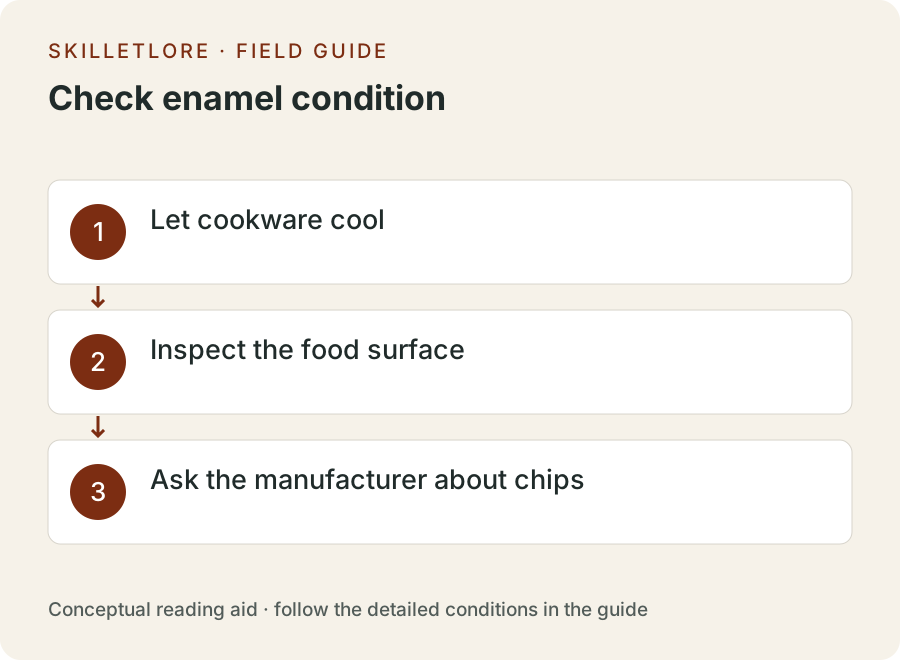
Diagnostic Comparison: Crazing vs. Chipping vs. Metal Transfer Marks
Home cooks frequently discard expensive Dutch ovens over harmless spoon marks—or, conversely, continue simmering soup in a pot that is actively shedding glass splinters. Use the fingernail and magnification criteria below to distinguish the four conditions:
| Visual Appearance on Enamel | Fingernail Catch Test | Structural Mechanism | Food-Safety & Usage Verdict |
|---|---|---|---|
| Gray Pencil-Like Scuffs on Light Enamel | Smooth — fingernail glides across without catching. | Soft stainless steel utensils (Mohs ~5.5) rubbed off microscopic metal tracks onto harder porcelain glass (Mohs 6.0–6.5). |
Possible utensil transfer: Use only a cleaner approved by the cookware manufacturer. Inspect again after gentle cleaning; a mark cannot be certified harmless from its color alone. |
Brown-Stained Spiderweb Hairlines (Crazing) |
Barely perceptible hairline groove; no missing craters or flaking edges. | Tensile thermal shock opened 1–5 µm vertical cracks in the cover coat without delaminating it from the ground coat. |
Usable with Caution: Safe for cooking so long as no glass flakes catch on a fingernail; avoid all future thermal shocks. |
| Rim Nick on Top Lip or Lid Edge | Catches on the outer rim only; interior cooking bowl is intact. | Mechanical bump against sink faucet, oven rack, or lid storage. | Safe to Use: Wipe a tiny drop of cooking oil on the exposed dark rim spot to prevent rust; keep out of the dishwasher. |
Interior Floor Crater Exposing Dark Iron (Chip / Spall) |
Deep crater (0.5–1.5 mm) with sharp, undermined glass cliff edges. |
Severe mechanical drop/impact or dry high-heat thermal spalling detached glass down to the iron core. | UNSAFE for Liquid Cooking: Surrounded by stressed glass that can flake sharp splinters into stew. Retire or line with heavy parchment for dry bread baking only. |
Safe Preheating Rules & Non-Abrasive Stain Removal Chemistry
- Never Preheat Enameled Cast Iron Completely Dry on the Stovetop: Always add
1 to 2 teaspoonsof oil, butter, or water to the cold pot before turning on the burner, and start on low to medium-low heat (3/10 to 5/10) for 4 minutes. (The sole exception is preheating an empty Dutch oven inside a convection/radiant oven for sourdough bread, where hot air warms the lid, walls, and base uniformly from all sides; even then, place the cold pot in the cold oven and let them preheat together.) - Removing Brown Polymerized Stains Without Bleach: Never soak enameled cast iron in household chlorine bleach (
NaOCl), which dulls the vitreous glaze and corrodes the exposed ground-coat rim. Instead, use warm sodium percarbonate (OxiClean Freeor2 tbsp baking soda + 2 tbsp 3% hydrogen peroxidein4 cupswarm water): simmer gently for10 minutesand wipe clean with a soft cellulose sponge.
Practical check: what to observe
Photograph the location, scale and edge of the defect and note whether it changes after ordinary washing. Do not deliberately cycle a damaged pot between hot and cold water to test it. There is no universal safe thermal-shock temperature for every enamel system.
- Let cookware cool
- Inspect the food surface
- Ask the manufacturer about chips
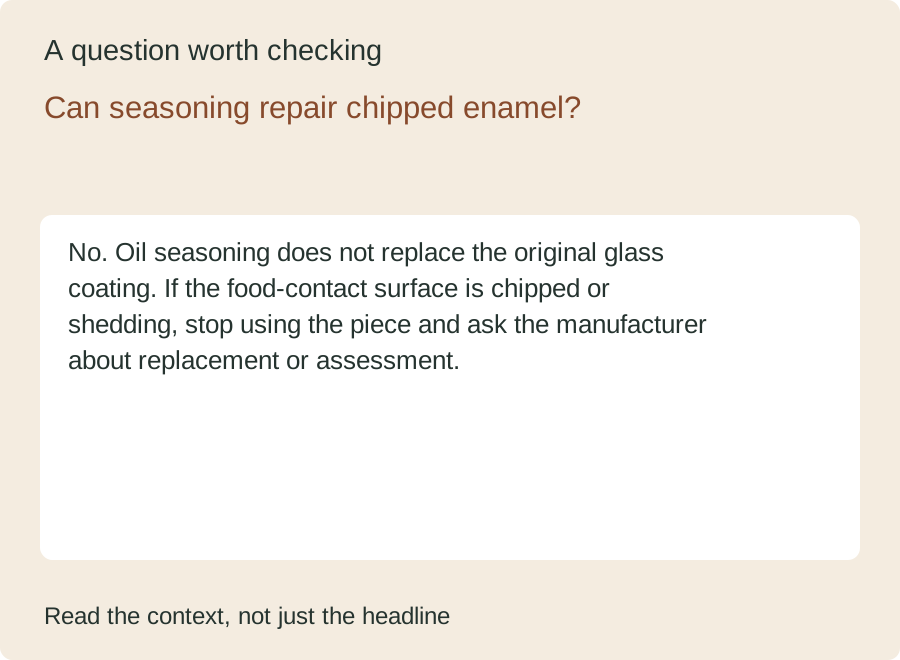
Can seasoning repair chipped enamel?
No. Oil seasoning does not replace the original glass coating. If the food-contact surface is chipped or shedding, stop using the piece and ask the manufacturer about replacement or assessment.
For more context, see the topic FAQ and glossary. A reference value or example should be read with its units, assumptions and product-specific conditions.
Sources and scope
The references below were supplied with the original manuscript. A reference is not evidence that every numerical claim has been independently checked. See the source library and our verification status.
- ASTM C283 / C282 – Standard Test Methods for Resistance of Porcelain Enameled Utensils to Boiling Acid and Thermal Shock
- Porcelain Enamel Institute (PEI) Technical Manual – Thermal Expansion Mismatch and Residual Stress in Cast Iron Enameling
- Journal of the American Ceramic Society – Thermal Shock Fracture Mechanics of Vitreous Enamel Coatings on Metallic Substrates
Put the explanation to work
Continue reading
Spot a questionable claim or a calculation issue? Read our correction process and contact information. Examples and illustrations are educational; they do not establish product suitability or a laboratory result.