 SkilletLore
Stainless & Carbon Steel Thermodynamics
Carbon steel bluing and first seasoning
A newly purchased carbon steel pan may arrive waxed, oiled, preseasoned, or fitted with a handle that limits oven use.
Before you start
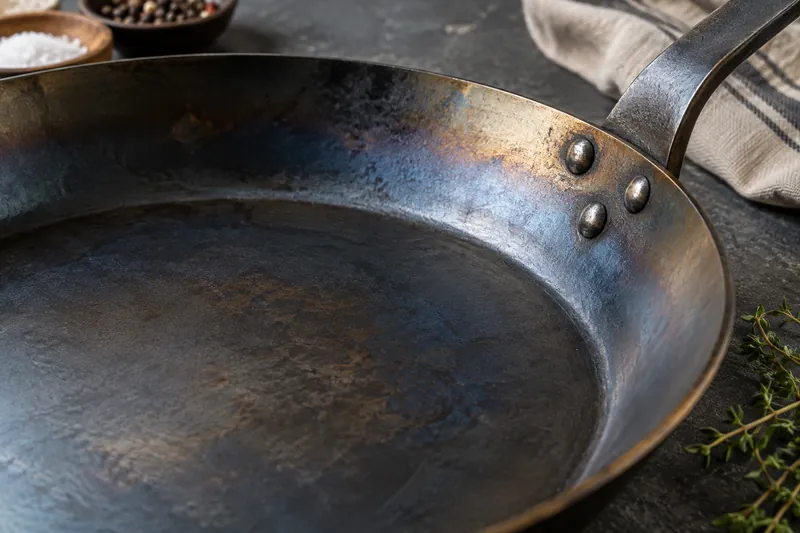
A newly purchased carbon steel pan may arrive waxed, oiled, preseasoned, or fitted with a handle that limits oven use. Identify that finish before applying heat. Bluing is not required by every manufacturer, and surface color is not a reliable thermometer. A small induction ring can heat the center much faster than the rim.
Anyone who has watched a traditional Cantonese chef break in a new carbon steel wok (kuo) over a roaring jet burner—or unboxed a French 2.5–3.0 mm stamped carbon steel skillet (De Buyer Mineral B, Matfer Bourgeat, Darto)—has witnessed a striking metallurgical transformation. Before a single drop of oil touches the pan, the scrubbed silver steel is heated dry until a wave of golden straw, violet, deep peacock blue, and finally slate blue-gray sweeps across the metal. This process, known in gunsmithing, watchmaking, and metallurgy as thermal bluing, is not merely cosmetic. It converts highly reactive bare metallic iron (Fe⁰) into a passivating, corrosion-resistant nanocrystalline ceramic layer of magnetite (Fe₃O₄) that solves carbon steel’s biggest weakness: weak initial seasoning adhesion. You can compare carbon steel heat tint against other cookware surface phenomena in our Cast Iron, Carbon Steel & Clad Stainless Defect Diagnostic Matrix.
Why Smooth Stamped Carbon Steel Sheds Seasoning Easier Than Cast Iron
Both cast iron and carbon steel are iron-carbon alloys, but their carbon content and manufacturing surface roughness (R_a) differ radically:
- Gray Cast Iron (
ASTM A48,2.8–3.5% Carbon): Cast in sand molds and shot-blasted, leaving a macroscopically rough, matte gray surface (R_a ≈ 4.0 to 12.0 µm) pitted with microscopic graphite-flake cavities that mechanically lock polymerized oil in place. - Cold-Rolled Stamped Carbon Steel (
AISI 1010–1020,0.08–0.22% Carbon,98.5–99% Fe): Rolled between hardened steel mill cylinders under high tonnage, yielding a mirror-smooth, non-porous ferritic surface (R_a ≈ 0.25 to 0.60 µm).
Because smooth stamped carbon steel has almost zero mechanical tooth (R_a < 0.6 µm), wiping oil directly onto raw, unoxidized silver steel frequently results in blotchy seasoning that strips off the first time you deglaze a pan or sear a marinated protein. Growing a controlled magnetite (Fe₃O₄) conversion layer before oiling provides both sub-micron crystalline micro-roughness and dense Fe²⁺/Fe³⁺ coordination sites for free-radical oil cross-linking (Polymerization Chemistry: How Drying Oils Bond to Raw Iron).
Solid-State Oxidation Kinetics: Fe⁰ → Fe₃O₄ vs. Red Rust Fe₂O₃
Iron forms three distinct oxides with oxygen, two of which are destructive rust and one of which is a protective ceramic barrier:
- Hydrated Ferric Oxyhydroxide (
FeO(OH)/Fe₂O₃ · nH₂O, Red/Orange Rust): Forms in the presence of liquid water and dissolved oxygen at room temperature (20–80 °C). Its crystal lattice has a Pilling-Bedworth Ratio (PBR = V_oxide / V_metal) of> 2.1, meaning the rust swells to more than double the volume of the iron it consumed—cracking, flaking, and exposing fresh metal underneath. - Magnetite (
Fe₃O₄, orFeO · Fe₂O₃, Black-Blue Iron(II,III) Oxide): Forms by dry thermal oxidation in air between260 °C and 325 °C (500 °F and 617 °F):
Dry Thermal Bluing Reaction (270°C – 315°C in Atmospheric O₂):
  3 Fe⁰(s) + 2 O₂(g)  ──[ΔT = 285–315°C]──>  Fe₃O₄(s) (Inverse Spinel Magnetite Lattice)
Unlike flaky red rust, thermally grown magnetite crystallizes in a tight cubic inverse spinel lattice containing both divalent (Fe²⁺) and trivalent (Fe³⁺) cations. It adheres tenaciously to the underlying alpha-ferrite grain structure, acts as a solid-state diffusion barrier that slows moisture and oxygen penetration by more than 10×, and directly catalyzes lipid hydroperoxide radical branching during seasoning.
Thin-Film Interference Physics: Reading Oxide Thickness by Color
Why does heating carbon steel turn it straw yellow at 440 °F, purple at 520 °F, vibrant cobalt blue at 570 °F, and blue-gray at 610 °F? Magnetite itself is black-gray in bulk, but a freshly grown film between 20 nm and 90 nm thick is semi-transparent to visible light (λ = 400–700 nm).
When white kitchen light strikes the skillet at angle θ, part of the light reflects off the top air-oxide boundary, while the rest refracts through the Fe₃O₄ film (refractive index n ≈ 2.42), reflects off the bottom oxide-steel boundary, and exits back into the air. The optical path difference (Δ = 2 · n · d · cos θ) causes destructive interference for specific wavelengths and constructive reinforcement for their complementary colors:
Thin-Film Constructive Interference Equation (taking phase inversions into account):
  2 × n_Fe3O4 × d × cos(θ) = m × λ
  where:
    n_Fe3O4 ≈ 2.42 (refractive index of magnetite in visible spectrum)
    d       = physical thickness of the Fe₃O₄ oxide film (nanometers, nm)
λ = reinforced visible wavelength (nm)| Temper / Bluing Color | Surface Temperature (°F / °C) |
Oxide Film Thickness (d, nm) |
Metallurgical Status for Carbon Steel Cookware |
|---|---|---|---|
| Faint Pale Yellow | 400–430 °F (204–221 °C) |
~20–25 nm |
Too Thin: Incomplete surface oxidation; continue heating. |
| Golden Straw / Bronze | 450–490 °F (232–254 °C) |
~30–38 nm |
Early Transition: Mixture of ultra-thin Fe₃O₄ and outer α-Fe₂O₃. |
| Purple / Violet-Red | 510–535 °F (266–279 °C) |
~45–52 nm |
Approaching Target: Rapid spinel nucleation across the pan floor. |
| Deep Cobalt / Peacock Blue | 550–585 °F (288–307 °C) |
~60–72 nm |
Optimal Bluing Window: Continuous, dense Fe₃O₄ passivation layer. |
| Slate Blue-Gray / Silver-Gray | 590–620 °F (310–327 °C) |
~75–90 nm |
Full Wok Passivation: Maximum durable Fe₃O₄ thickness before scale growth. |
| Dull Powdery Gray (>700°F) | > 700 °F (> 371 °C) |
> 200 nm |
Overheated: Brittle mill-scale growth (wüstite FeO onset above 570 °C); risks pan warp. |
Step-by-Step Workshop Protocol: Stripping Factory Wax, Bluing, and First Seasoning
Every new carbon steel skillet or wok ships coated in beeswax, paraffin, lanolin, or industrial cosmoline/mineral oil to prevent warehouse rust. Never blue a pan before stripping this factory coating completely—otherwise the wax chars into sticky, uneven black streaks that block oxygen from reaching the steel.
- Strip Factory Shipping Coating (
100% Bare Silver Steel):- For beeswax-coated pans (
De Buyer Mineral B): Pour1 inchof boiling water into the pan to melt the wax, pour it into the trash (not down the drain), and scrub vigorously with very hot water, Dawn dish soap (Soap vs. Seasoning), Bar Keepers Friend (or baking soda), and a green Scotch-Brite pad until water sheets evenly across bare silver steel without beading. - For industrial lacquer/oil coatings (traditional Chinatown woks): Scrub with dish soap and steel wool; if factory lacquer is stubborn, soak for 20 minutes in hot washing soda (
Na₂CO₃) or strip with yellow-cap oven cleaner.
- For beeswax-coated pans (
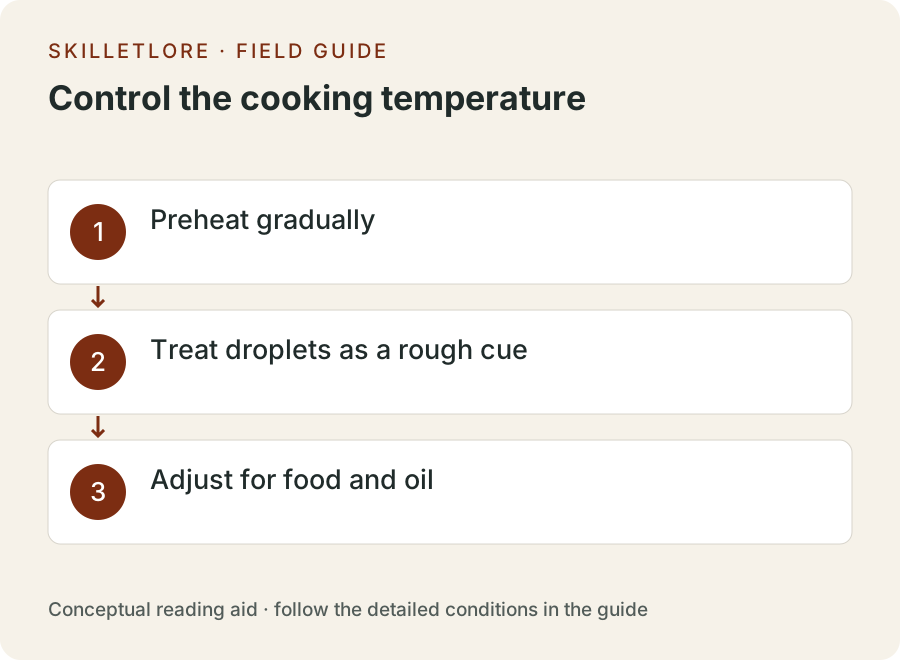
- Dry & Heat Gradually to Avoid Spinner Warpage (
550–600 °F):- Dry the pan completely with a paper towel.
- Gas Burner (Best for Woks & Skillets): Start on medium heat (
3 minutes) so the heavy floor expands evenly before turning the burner to medium-high. Watch the center turn straw gold → purple → cobalt blue → slate blue-gray. Tilt and rotate the pan slowly so the blue wave climbs all the way up the sidewalls and rim. - Oven or Induction Alternative: If cooking on flat glass induction (where tilting a pan is impossible and rapid high power warps thin steel), preheat the dry scrubbed pan in a
500 °F (260 °C)oven or broil for15–20 minutesto achieve a uniform bronze-violet oxide film without radial thermal shock.
- Cool to
350 °F (177 °C)& Apply Micro-Thin Seasoning Oil:- Let the blued pan cool for
3–4 minutesuntil it drops to~350–400 °F(so oil does not flash-burn on impact). - Wipe
1/2 teaspoonof refined grapeseed (IV 134), canola (IV 114), or soybean oil (IV 130) (Oil Smoke Point & Polymerization Matrix) across the hot blued interior and exterior, buff immediately with a clean dry paper towel until no wet streaks remain, and heat for90 secondsuntil thefirst wisp of smoke subsides.
- Let the blued pan cool for
Practical check: what to observe
Inspect the base on a flat surface before and after preparation. Log the hob setting and heating approach. Stop if the pan deforms, the coating smokes unexpectedly, or a handle exceeds its stated limit.
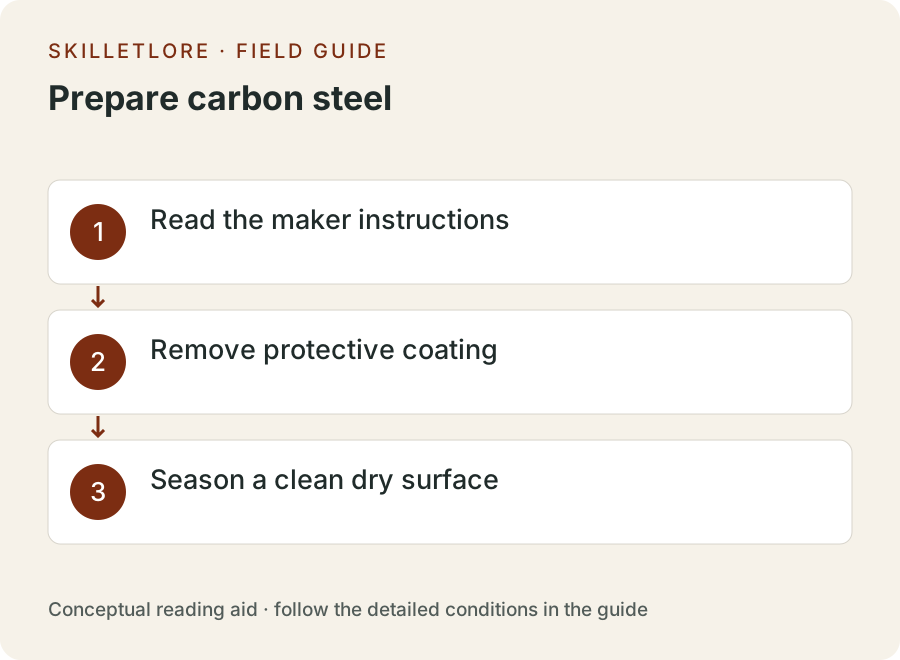
- Read the maker instructions
- Remove protective coating
- Season a clean dry surface
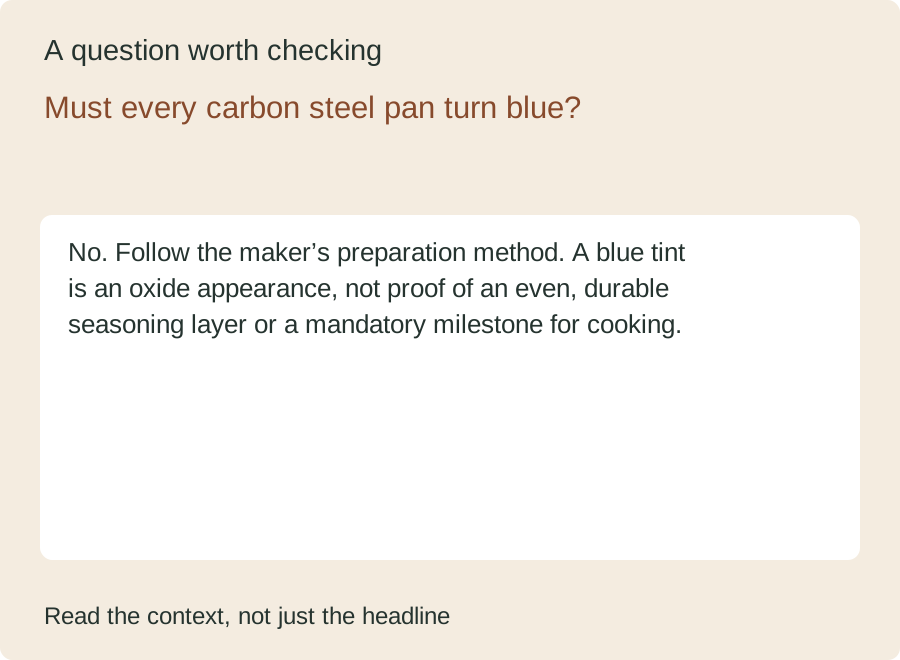
Must every carbon steel pan turn blue?
No. Follow the maker’s preparation method. A blue tint is an oxide appearance, not proof of an even, durable seasoning layer or a mandatory milestone for cooking.
For more context, see the topic FAQ and glossary. A reference value or example should be read with its units, assumptions and product-specific conditions.
Sources and scope
The references below were supplied with the original manuscript. A reference is not evidence that every numerical claim has been independently checked. See the source library and our verification status.
Put the explanation to work
Continue reading
Spot a questionable claim or a calculation issue? Read our correction process and contact information. Examples and illustrations are educational; they do not establish product suitability or a laboratory result.