 SkilletLore
Stainless & Carbon Steel Thermodynamics
Clad stainless steel: aluminum vs copper
Two pans both described as five-ply need not behave alike.
Before you start
Two pans both described as five-ply need not behave alike. Layer count does not reveal the thickness of the conductive core, and a thick disc base behaves differently from metal extending up the sidewall. Compare pan diameter, mass, handle design and compatibility as well as the core material.
Walk down any cookware aisle and you will see stainless steel skillets marketed with escalating “ply” numbers—3-ply, 5-ply, 7-ply, copper-core, and disc-bottom—often accompanied by claims that five layers of metal automatically cook twice as evenly as three layers. In heat-transfer engineering, counting plies without measuring core alloy composition (3003 Al vs. C11000 Cu) and core gauge thickness (mm) is meaningless. Understanding the three fundamental thermophysical equations—In-Plane Thermal Conductance (k · d), Volumetric Heat Capacity (ρ · c_p), and Thermal Diffusivity (α = k / (ρ · c_p))—reveals why bare stainless needs a conductive core, why some 5-ply pans actually heat less evenly than 3-ply pans, and how clad stainless compares against heavy gray cast iron. You can pair these thermal principles with our Leidenfrost Nonstick Temperature Window Guide and troubleshoot stainless heat tint and chloride pitting in our Cookware Defect Diagnostic Matrix.
Why Pure Stainless Steel Cannot Spread Heat on Its Own
Cookware requires two conflicting properties: a non-reactive, scratch-resistant cooking surface and high lateral thermal conductivity so burner rings do not scorch a ring of garlic while leaving the center raw.
- 304 Austenitic Stainless Steel (
18% Cr, 8–10% Ni,18/8or18/10): Forms a self-healing2–3 nmpassive chromium(III) oxide (Cr₂O₃) skin that is impervious to wine, vinegar, and tomatoes. However, Adding26–28%chromium and nickel alloy atoms scatters free electrons and phonons in the crystal lattice, dropping its thermal conductivity (k) to just16.2 W/m·K—more than 3 times lower than cast iron (52 W/m·K) and 14 to 24 times lower than aluminum or copper! - 430 Ferritic Stainless Steel (
16–18% Cr, ~0% Ni): Used as the bottom exterior skin on modern clad pans because its body-centered cubic (BCC) crystal structure is ferromagnetic (high magnetic permeabilityµ_r), allowing high-frequency (20–50 kHz) induction cooktops to induce eddy currents and hysteresis heating (304austenitic stainless is non-magnetic and will not trigger an induction burner on its own).
The Three Thermophysical Equations That Govern Every Pan
To compare cast iron, carbon steel, aluminum, copper, and stainless steel objectively, engineers evaluate three physical constants at 25–200 °C:
1. Fourier Lateral Heat Conduction (Evenness Across the Skillet Floor):
   Q_radial ∝ k × d_core
   where:
     k      = Thermal conductivity (W/m·K)
     d_core = Thickness of the high-conductivity aluminum or copper core (mm)

2. Volumetric & Areal Heat Capacity (Thermal Mass / Sear Retention per cm²):
   C_vol  = ρ × c_p                   (J / cm³·K)
   C_area = ρ × c_p × d_total         (J / cm²·K)
   where:
     ρ   = Density (g/cm³)
     c_p = Specific heat capacity (J/g·K)

3. Thermal Diffusivity (Speed of Temperature Change / Burner Responsiveness):
α = k ÷ (ρ × c_p) (mm²/s)| Cookware Metal / Alloy | Density ρ (g/cm³) |
Specific Heat c_p (J/g·K) |
Volumetric Heat Capacity ρ·c_p (J/cm³·K) |
Thermal Conductivity k (W/m·K) |
Thermal Diffusivity α (mm²/s) |
|---|---|---|---|---|---|
| C11000 Pure Copper | 8.94 |
0.385 |
3.44 J/cm³·K |
388 W/m·K |
112.8 mm²/s |
| 1145 / 3003 Aluminum Core | 2.73 |
0.897 |
2.45 J/cm³·K |
190–230 W/m·K |
77.6–93.9 mm²/s |
| ASTM A48 Gray Cast Iron | 7.15 |
0.490 |
3.50 J/cm³·K |
52 W/m·K |
14.9 mm²/s |
| AISI 1010 Carbon Steel | 7.87 |
0.486 |
3.82 J/cm³·K |
50 W/m·K |
13.1 mm²/s |
| 430 Ferritic Stainless (Base) | 7.75 |
0.460 |
3.56 J/cm³·K |
26.1 W/m·K |
7.3 mm²/s |
304 Austenitic Stainless (18/8) |
8.00 |
0.500 |
4.00 J/cm³·K |
16.2 W/m·K |
4.05 mm²/s |
Look closely at the table above—it resolves two classic cookware misconceptions:
- Cast Iron Has High Volumetric Heat Capacity (
3.50 J/cm³·K), NOT High Conductivity: Gray cast iron’s thermal diffusivity (α = 14.9 mm²/s) is 6 times slower than aluminum (85 mm²/s) and 7.5 times slower than copper (112.8 mm²/s). Cast iron sears steaks brilliantly because a thick4.5 mmiron floor stores1.58 J/cm²·Kof thermal energy (C_area), refuses to drop below Maillard temperature when cold meat hits the pan, and radiates infrared heat steadily—provided you preheat it gradually for 5–8 minutes so heat conducts laterally across the floor. - Aluminum vs. Copper Core Weight & Thermal Mass: Aluminum has
3.3×lower density than copper (2.73vs.8.94 g/cm³), but more than double the specific heat per gram (0.897vs.0.385 J/g·K). Consequently, per millimeter of thickness (ρ · c_p),1.0 mmof copper holds3.44 J/cm³·Kwhile1.4 mmof aluminum holds the exact same heat capacity (3.43 J/cm³·K) at less than half the weight!
Why Core Thickness (mm) Beats Marketing “Ply Count” (3-Ply vs. 5-Ply)
In roll-bonded clad stainless cookware, sheets of stainless steel and aluminum/copper are bonded under extreme rolling mill pressure and diffusion-annealed. Why can a 3-ply skillet outperform a 5-ply skillet of the exact same 2.6 mm total wall thickness?
- Standard
2.6 mm3-Ply (All-Clad D3style): Consists of0.4 mminner 304 stainless +1.7 mmcontinuous aluminum core +0.5 mmouter 430 stainless. Lateral thermal conductance (k · d_Al) ≈200 W/m·K × 1.7 mm = 340 W/K. - Budget
2.6 mm5-Ply (with internal stainless divider): Inserts an extra thin sheet of low-conductivity stainless steel (k = 16 W/m·K) right through the middle of the core (SS / Al / SS / Al / SS), reducing the total aluminum thickness from1.7 mmto1.3 mm! Unless a5-plypan is made thicker overall (3.0 to 3.8 mm, such asDemeyere Proline 7-plywith a3.0 mmaluminum core), adding extra stainless layers inside a thin wall actually reduces lateral heat spreading while slightly slowing thermal responsiveness.
| Clad Architecture | Total Gauge (mm) |
Conductive Core Thickness | Lateral Conductance (∑ k·d) |
Best Culinary Role |
|---|---|---|---|---|
Standard 3-Ply (SS / Al / SS) |
2.6–2.8 mm |
1.7–1.9 mm Aluminum |
~350–390 W/K |
Fast, lightweight everyday sautéing, pan sauces, and Leidenfrost egg frying. |
Heavy-Gauge 3-Ply / 5-Ply |
3.2–4.8 mm |
2.3–3.7 mm Aluminum |
~480–750 W/K |
High-thermal-mass steak searing rivaling cast iron with far superior evenness. |
Copper-Core 5-Ply (SS/Al/Cu/Al/SS) |
2.8–3.0 mm |
0.9 mm Cu + 0.9 mm Al |
~530 W/K |
Ultra-fast temperature step-up and step-down (α > 95 mm²/s) for delicate reductions. |
Impact-Bonded Disc Base (5–6 mm Al/Cu) |
5.5–7.0 mm (floor) |
4.5–5.5 mm Al or 2 mm Cu disc |
> 900 W/K (floor only) |
Stockpots, pasta pots, and flat-bottom induction braisers (avoid on high-flare gas flames that scorch unclad sidewalls). |
To prevent salt pitting and rainbow oxide interference on your clad stainless pans, always add salt only after water reaches a rolling boil (100 °C) and review our Leidenfrost Effect Nonstick Temperature Window Guide.
Practical check: what to observe
For a simple kitchen comparison, keep burner, water mass and starting temperature the same. Record heating and cooling behavior separately. The result describes those pans on that burner; it is not a measurement of intrinsic thermal conductivity.
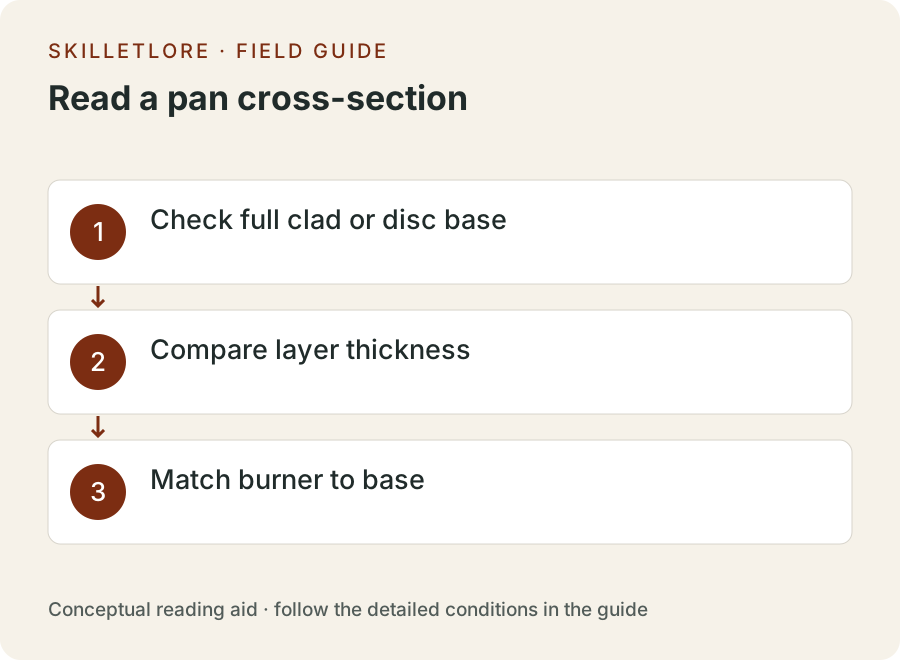
- Check full clad or disc base
- Compare layer thickness
- Match burner to base
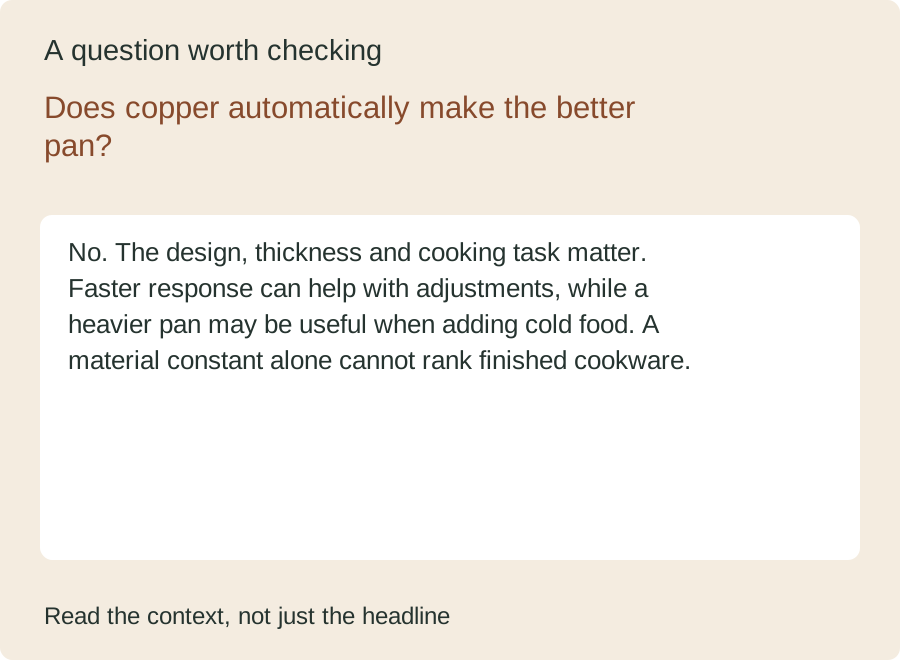
Does copper automatically make the better pan?
No. The design, thickness and cooking task matter. Faster response can help with adjustments, while a heavier pan may be useful when adding cold food. A material constant alone cannot rank finished cookware.
For more context, see the topic FAQ and glossary. A reference value or example should be read with its units, assumptions and product-specific conditions.
Sources and scope
The references below were supplied with the original manuscript. A reference is not evidence that every numerical claim has been independently checked. See the source library and our verification status.
- ASM Metals Handbook Desk Edition – Thermophysical Properties of Steels, Aluminum Alloys, and Copper
- Fundamentals of Heat and Mass Transfer (Incropera & DeWitt) – Composite Wall Conduction and Thermal Diffusivity
- ASTM A240 / A240M – Standard Specification for Chromium and Chromium-Nickel Stainless Steel Plate and Sheet
Put the explanation to work
Continue reading
Spot a questionable claim or a calculation issue? Read our correction process and contact information. Examples and illustrations are educational; they do not establish product suitability or a laboratory result.