 SkilletLore
Explainers
Carbon steel vs cast iron care: what actually differs
Same family of bare-metal care—different mass, rust speed, and unboxing steps. A practical comparison without brand folklore.
In plain language
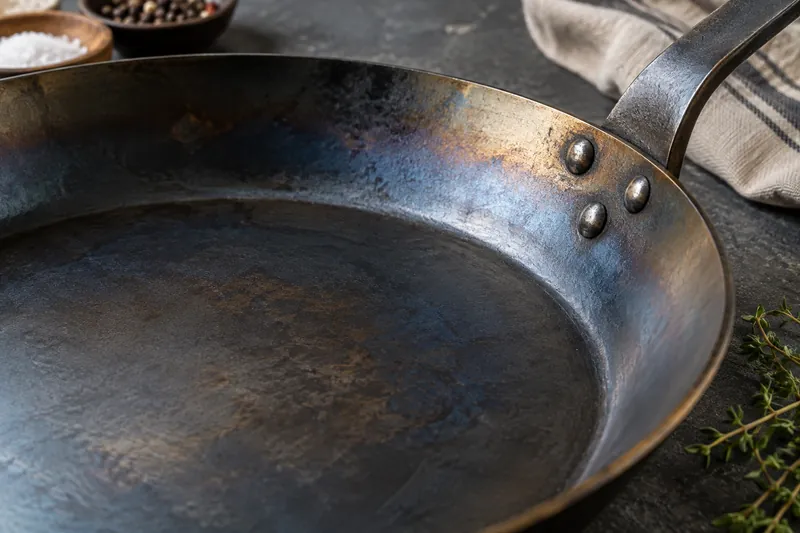
Carbon steel and cast iron share bare-metal habits—controlled heat, enough fat, thorough drying, and dry storage—but differ in mass, how fast rust appears, and how quickly a working patina forms. Care advice should name the metal rather than treat them as identical pans.
What this assumes: Home kitchen bare carbon steel and cast iron; enamel and nonstick stacks are out of scope unless explicitly named.
Before you start
Carbon steel and bare cast iron both want dry storage and thin polymerized oil—but they differ in weight, heat-up speed, rust flash, and how forgiving sticky mistakes feel.
What they share
Both are bare ferrous cooking surfaces protected partly by seasoning (polymerized oil) rather than a factory PTFE coating. Both dislike dishwashers and prolonged wet storage. Both benefit from the same first-month discipline: clean food film, dry fully, oil thinly when the surface looks dry or ashy.
Care differences that matter
- Mass and preheat — Cast iron is usually thicker and slower to heat evenly; carbon steel often responds faster and can hotspot on an oversized burner more dramatically.
- Flash rust — Thin carbon steel can show orange bloom quickly after washing if left damp. Dry to the touch, then a whisper of oil if you will store it.
- Sticky seasoning — The same excess-oil problem appears on both; troubleshooting steps are shared—see the sticky guide before stripping.
- First factory state — New carbon steel may arrive with a wax or oil film that needs removal before seasoning; cast iron may be preseasoned. Read the maker card rather than assuming identical unboxing.
- Bluing / magnetite — Some carbon-steel routines mention bluing before oil seasoning; that is a different step from everyday cast-iron care—see the bluing guide if that is your path.
Choosing for a kitchen job
For searing steaks or tossing stir-fries, many cooks prefer carbon steel’s lighter feel. For cornbread, deep frying, or oven-to-table heat retention, cast iron’s mass helps. Neither choice replaces burner-size matching or pan-area math—open the choose-and-size hub when shopping.
Practical check
- Name the finish: bare CI, carbon steel, or enamel (enamel is a different care tree).
- After washing, confirm the pan is fully dry before storage.
- If sticky, troubleshoot oil thickness before a full strip.
Do carbon steel and cast iron use the same seasoning oil?
Both rely on polymerized oil films on bare metal, but thickness, heat response, and rust speed differ. Prefer thin coats on both; see the oil matrix for smoke-point and iodine-value context.
Which rusts faster if left wet?
Both rust when wet and unprotected. Carbon steel’s thinner walls often show flash rust quickly after washing if not dried—dry thoroughly either way.
Can I treat carbon steel like a nonstick skillet?
No. It is not PTFE nonstick. Preheat, fat, and a maintained patina matter; dishwasher and long acid soaks are poor defaults.
Sources and scope
Editorial comparison for home cooks. Product-specific factory finishes vary—follow the maker’s card when it conflicts with general advice. Editorial policy.
Continue reading
Spot a questionable claim or a calculation issue? Read our correction process and contact information. Examples and illustrations are educational; they do not establish product suitability or a laboratory result.