 SkilletLore
Stainless & Carbon Steel Thermodynamics
Stainless steel preheating and the water-drop test
Water droplets can behave differently as a pan heats, but the transition depends on the surface and the droplet.
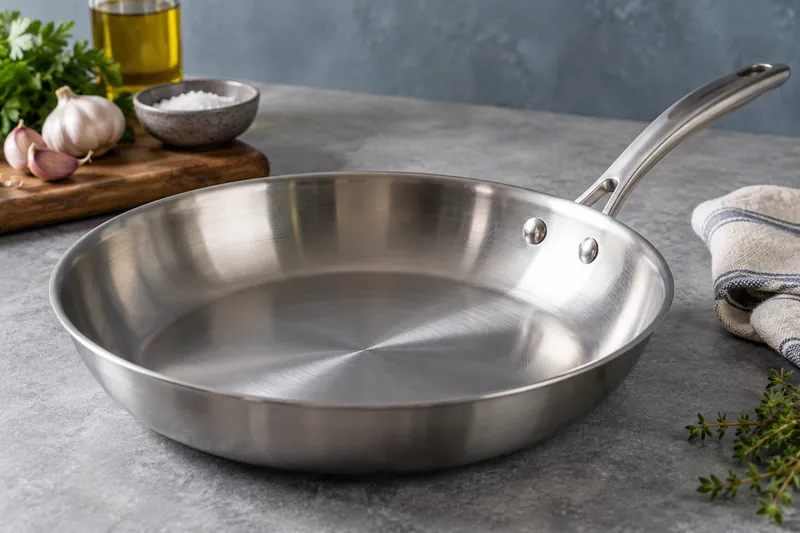
Before you start
Water droplets can behave differently as a pan heats, but the transition depends on the surface and the droplet. A skating bead is not a calibrated temperature reading, and it is not the right target for every ingredient. Butter, delicate fish and a high-heat sear need different handling.
Home cooks switching from PTFE (Teflon) pans or seasoned cast iron to bare multi-ply stainless steel (AISI 304 / 18-8 or 316Ti) almost universally experience the same frustration: a chicken breast, salmon fillet, or fried egg welds itself so tenaciously to the brushed steel floor that scraping it loose leaves half the meal behind. Yet professional restaurant line cooks fry eggs and sear skin-on fish in unseasoned stainless pans every service without sticking. The secret is not “seasoning” stainless steel—it is crossing the nucleate-to-film boiling boundary (T_L ≈ 193 °C / 379 °F), discovered by Johann Gottlob Leidenfrost in 1756. You can troubleshoot stainless sticking, rainbow chromium-oxide heat tint, and white mineral scale in our Cast Iron, Carbon Steel & Clad Stainless Defect Diagnostic Matrix.
Why Food Welds to Bare Stainless Steel: Oxide Coordination Chemistry
Bare austenitic stainless steel (18% Cr, 8–10% Ni, balance Fe) owes its corrosion resistance to a spontaneous, self-healing 2 to 3 nm passive surface film of hydrated chromium(III) oxide (Cr₂O₃ · nH₂O) and iron oxide. At the atomic scale, this oxide layer is covered with polar hydroxyl groups (-Cr-OH and -Fe-OH), making bare stainless steel hydrophilic (high surface energy)—the exact opposite of hydrophobic polymerized cast iron seasoning (Polymerization Chemistry Guide).
Raw muscle proteins (myosin, actin, albumin in egg whites) are folded chains of amino acids containing reactive nucleophilic side groups: cysteine thiols (-SH), lysine amines (-NH₂), and glutamic/aspartic carboxylates (-COO⁻). When cold, wet protein touches a stainless pan at the wrong temperature (110–165 °C / 230–329 °F):
- Nucleate Boiling Displaces Oil: Surface moisture on the food flashes into violent nucleate steam bubbles inside the
1–3 µmbrushed grain valleys of the steel, pushing liquid cooking oil aside. - Coordinate Covalent Chelation: As heat unfolds (denatures) the protein chains, exposed
-SH,-NH₂, and-COO⁻ligands contact bare metal hydroxides and form chemical coordination complexes (Protein-S-Fe/CrandProtein-COO-Cr) with bond strengths (80–180 kJ/mol) stronger than the cohesive strength of the food itself.
The Four Regimes of the Boiling Curve on 304 Stainless Steel
When you flick a 0.5 mL (~1/8 teaspoon, d ≈ 5 mm) droplet of tap water onto a dry, preheating stainless skillet, the droplet’s behavior maps the exact Nukiyama pool-boiling curve across four distinct temperature regimes:
Heat Flux (q″) vs. Wall Superheat (ΔT = T_pan - 100°C):
  • Regime I   (T_pan < 100°C / 212°F):       Convective evaporation; flat puddle sits quietly.
  • Regime II  (100°C – 165°C / 212°F–329°F): Nucleate boiling; violent bubbling, gone in 0.8–2.0 sec. (MAXIMUM STICKING!)
  • Regime III (165°C – 192°C / 329°F–378°F): Transition boiling; droplet splinters into jittery sputtering beads.
  • Regime IV  (193°C – 245°C / 379°F–473°F): Stable Leidenfrost film boiling; single mercury-like sphere glides for 30–60+ sec!
Skillet Surface Temp (°C / °F) |
Boiling Regime | 0.5 mL Water Droplet Visual Test |
Thermal Heat Flux (q″) & Protein Sticking Behavior |
|---|---|---|---|
100–155 °C (212–311 °F) |
Nucleate Boiling | Spreads flat, hisses loudly, boils away in 1–2 seconds. |
Extreme Sticking: Liquid water wets steel valleys (contact angle θ < 40°), displacing oil and welding proteins to Cr₂O₃. |
160–190 °C (320–374 °F) |
Transition Regime | Breaks into 5–15 small dancing beads that sizzle and vanish in 4–8 seconds. |
Partial Sticking: Vapor film collapses intermittently under the weight of a cold steak or egg. |
193–225 °C (379–437 °F) |
Leidenfrost Window | Coalesces into one cohesive, silent sphere that rolls like liquid mercury for 30–60 seconds. |
Optimal Nonstick Searing: Continuous vapor cushion + hot low-viscosity oil prevents wet protein from wetting metal valleys. |
> 255 °C (> 491 °F) |
Superheated / Scorch | Droplet explodes on impact into tiny fast-moving pinballs (10–25 beads). |
Too Hot: Cooking oils smoke and scorch instantly (acrolein release); fond burns black before meat cooks through. |
Physics of the Leidenfrost Vapor Cushion (h ≈ 40–100 µm)
Why does a water droplet survive 30 times longer on a 200 °C (392 °F) skillet than on a 140 °C (284 °F) skillet? Once the pan floor exceeds the Leidenfrost temperature (T_L ≈ 193 °C on brushed 304 stainless steel), the bottom molecule layer of the water droplet flashes into steam faster than liquid can wet the microscopic roughness peaks (R_a ≈ 0.4–0.8 µm).
This generates a continuous, overpressurized steam cushion of thickness h ≈ 40 to 100 µm supporting the weight of the droplet (ρ_w · g · R). Because dry water vapor has a thermal conductivity (k_vapor ≈ 0.032 W/m·K at 150 °C) that is 21 times lower than liquid water (k_liquid ≈ 0.68 W/m·K), heat transfer across the gap drops by an order of magnitude:
Conductive Heat Flux Across the Leidenfrost Vapor Cushion:
  q″_film ≈ k_vapor × (T_pan - T_sat) ÷ h
  For T_pan = 200°C, T_sat = 100°C, h = 60 µm (6.0 × 10⁻⁵ m):
    q″_film ≈ 0.032 W/m·K × (100 K) ÷ (6.0 × 10⁻⁵ m) ≈ 5.3 × 10⁴ W/m²
    (Compared to > 6.0 × 10⁵ W/m² during violent nucleate boiling at 140°C!)
When you add cooking oil after the dry pan reaches 193–215 °C (379–419 °F) and then lay down a pat-dried steak, fish fillet, or egg:
- Dynamic Steam + Oil Barrier: Micro-moisture escaping the food surface immediately flashes into lifting steam micro-jets rather than wetting the steel, while the pre-warmed, low-viscosity oil (
ν < 4 mm²/s) floods every brushed grain valley. - Rapid Surface Maillard Crusting (for Proteins): Within
60 to 120 seconds, surface proteins cross-link with each other and undergo Maillard browning (> 140 °C), shrinking slightly and releasing cleanly from the steel oxides.
Step-by-Step Protocol: Searing vs. Frying Delicate Eggs on Stainless
Because a cold 225 g steak or two cold eggs drop the local surface temperature of a thin pan by 25 to 45 °C upon contact (see how aluminum vs. copper core thickness governs thermal recovery in Clad Stainless Steel Construction: Aluminum vs. Copper Core Thermal Diffusivity), adjust your post-Leidenfrost burner setting by food type:
Protocol A: High-Heat Searing (Steaks, Pork Chops, Skin-On Fish, Scallops)
- Dry Preheat (
2–3 minon Medium): Heat the completely dry, empty clad stainless skillet over medium heat (5/10). Never preheat on maximum high heat, which warps edges and creates rainbowCr₂O₃tint. - Run the
1/8 tspMercury Ball Test: Flick1/8 teaspoonof water into the pan. If it sizzles and evaporates, wait 30 seconds and retest. Once it glides as one single silent ball (195–215 °C), wipe out the water bead. - Add High-Smoke-Point Oil (
Wait 10 sec): Pour in1 tablespoonof refined avocado (520 °F), peanut (450 °F), or grapeseed (420 °F) oil (compare in our Cooking Oil Smoke Point & Polymerization Matrix). Swirl until the oil shimmers (10 seconds). - Lay Protein Down & Do Not Move for
90–120 Seconds: Pat the meat bone-dry with paper towels first. Lay it into the pan and do not tug on it for the first 90 seconds. Once the Maillard crust sets, the meat releases with gentle tongs pressure.
Protocol B: Delicate Eggs (The Temperature Step-Down Trick)
Egg whites coagulate between 62 °C and 85 °C and scorch instantly at 200 °C. To fry sliding eggs on bare stainless:
- Preheat dry on medium until the water droplet just passes the Leidenfrost mercury test (
193 °C). - Turn the burner DOWN to Low (
2/10), add1 teaspoonof neutral oil plus1/2 tablespoonof butter (whose soy-lecithin phospholipids act as an amphiphilic surfactant barrier), let the butter foam subside for15 seconds(cooling the pan floor into the150–160 °Csweet spot after hydrophobic wetting is established), and crack in the egg.
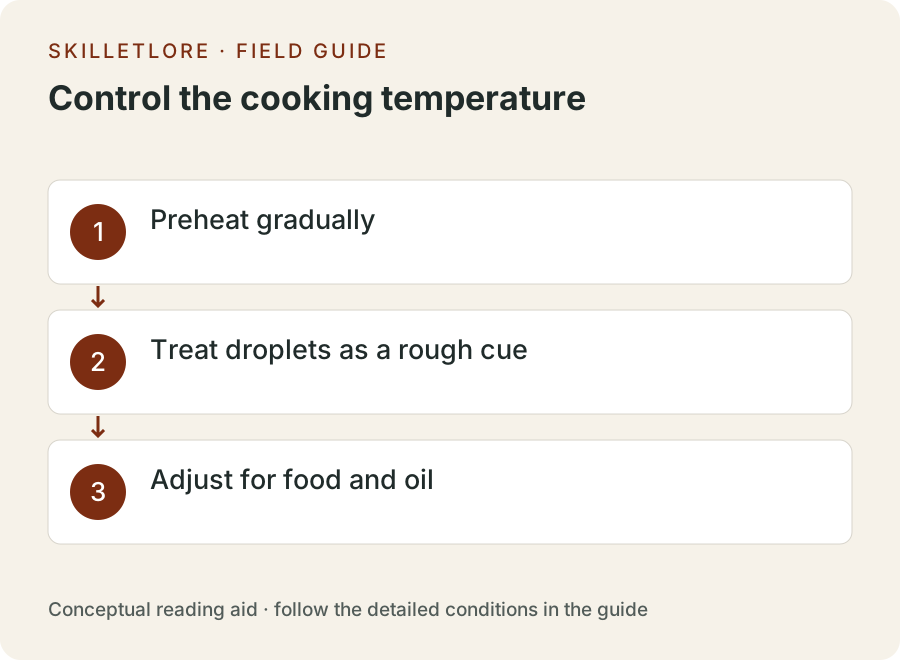
Practical check: what to observe
Record burner setting and preheat duration for your own pan, then judge browning with a small portion of food. Let an overheated pan cool safely. Never pour a large quantity of water into hot oil to check the temperature.
- Preheat gradually
- Treat droplets as a rough cue
- Adjust for food and oil
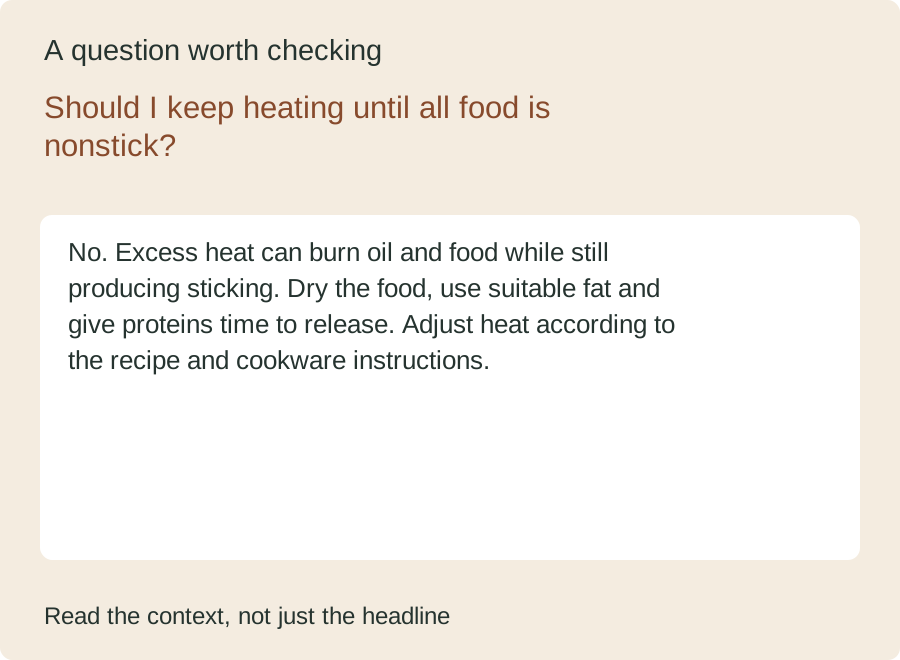
Should I keep heating until all food is nonstick?
No. Excess heat can burn oil and food while still producing sticking. Dry the food, use suitable fat and give proteins time to release. Adjust heat according to the recipe and cookware instructions.
For more context, see the topic FAQ and glossary. A reference value or example should be read with its units, assumptions and product-specific conditions.
Sources and scope
The references below were supplied with the original manuscript. A reference is not evidence that every numerical claim has been independently checked. See the source library and our verification status.
Put the explanation to work
Continue reading
Spot a questionable claim or a calculation issue? Read our correction process and contact information. Examples and illustrations are educational; they do not establish product suitability or a laboratory result.