 SkilletLore
In pictures
A cookbook calls for a different skillet: how to adapt the recipe
Compare usable pan areas, ingredient quantities and food depth before adapting a skillet recipe to another size.
Before you start
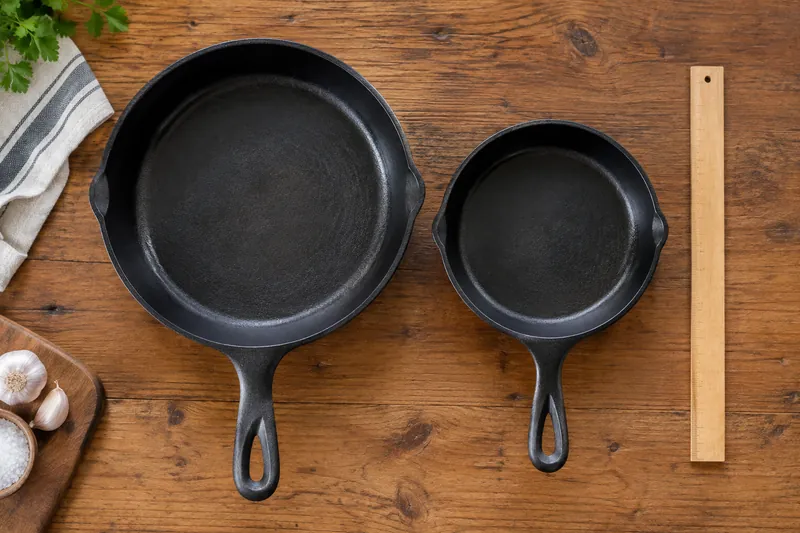
Compare flat cooking areas when you want a similar layer of food. A diameter ratio must be squared to obtain an area ratio. The result is a starting estimate for ingredient quantity, not a formula for cooking time or proof that your burner will heat the larger pan evenly.
Identify what the recipe assumes
Before multiplying anything, read the recipe for pan diameter, depth, material and whether it starts on the stove or in the oven. A shallow skillet and a deeper pot can hold the same volume while presenting quite different surfaces to the food.
A pan-focused book such as Cook It in Cast Iron supplies recipes for particular setups. This article is an independent calculation aid, not an adaptation of one of its recipes.
Compare the usable cooking floor
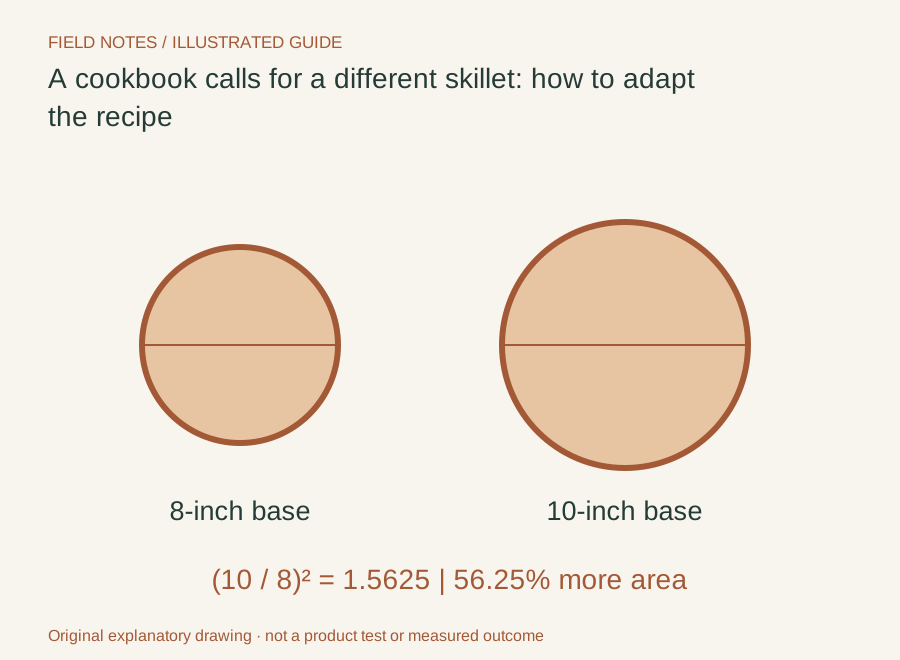
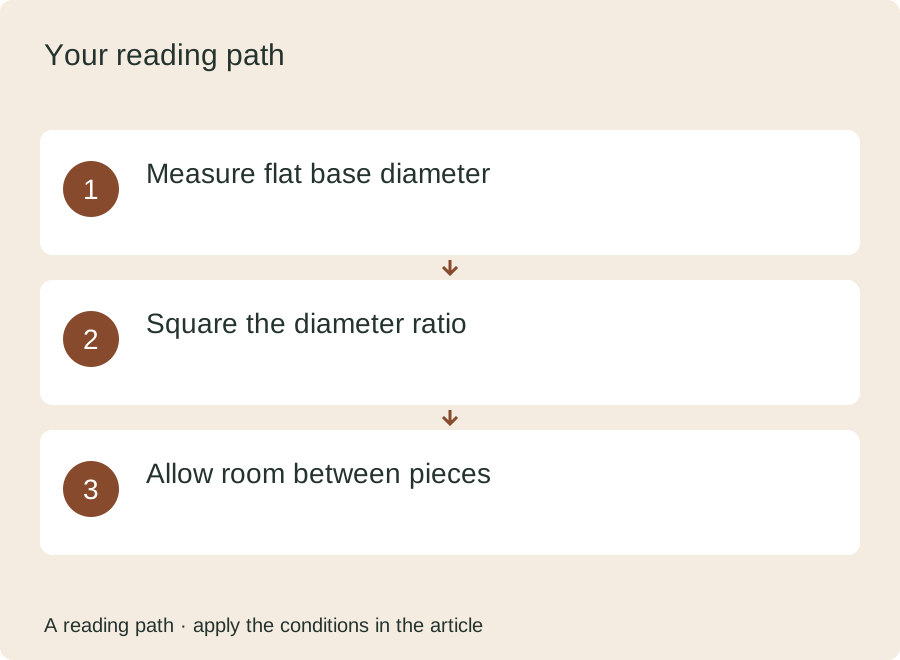
For a circular base, area is π × radius². If both bases are circular, the common constants cancel: the scaling factor is the new diameter squared divided by the original diameter squared.
Suppose the recipe’s usable base is 8 inches and yours is 10 inches. The factor is (10 ÷ 8)² = 1.5625. To maintain a similar layer depth in this idealized example, a quantity of 200 grams would become about 313 grams. The number is calculated, not measured from a cooked result.
| Original quantity | Exact multiplication | Practical planning value |
|---|---|---|
| 100 g | 100 × 1.5625 | About 156 g |
| 200 g | 200 × 1.5625 | About 313 g |
| 300 g | 300 × 1.5625 | About 469 g |
Use the pan size calculator to substitute your measurements. Do not mix centimeters for one pan with inches for the other.
Decide whether scaling is actually necessary
A recipe may still work in a slightly different pan without a proportional ingredient change. The useful question is what changes: the layer becomes thinner, the food has more room, or the liquid sits lower. Those changes may be welcome in one dish and inconvenient in another.
For separate pieces of food, sketch the arrangement with space between pieces. Mathematical area does not pack irregular shapes perfectly. For a batter or other continuous layer, depth is often a more useful observation than a nominal serving count.
Know where the calculation stops
Area scaling assumes comparable shapes and a similar desired depth. It does not tell you whether a handle clears the oven wall, whether the pan is rated for that heat, or whether your burner fits the new base. Check those separately.
It also does not make cooking time proportional to ingredient weight. A larger pan with more food is a changed cooking setup. Use the recipe’s appropriate doneness checks and observe the first attempt instead of calculating a timer from the area ratio.
Make one reversible first adjustment
If the conversion requires awkward fractions of indivisible ingredients, consider choosing another recipe or preparing separate batches. Do not silently round every ingredient in a different direction and then treat the result as a test of the pan.
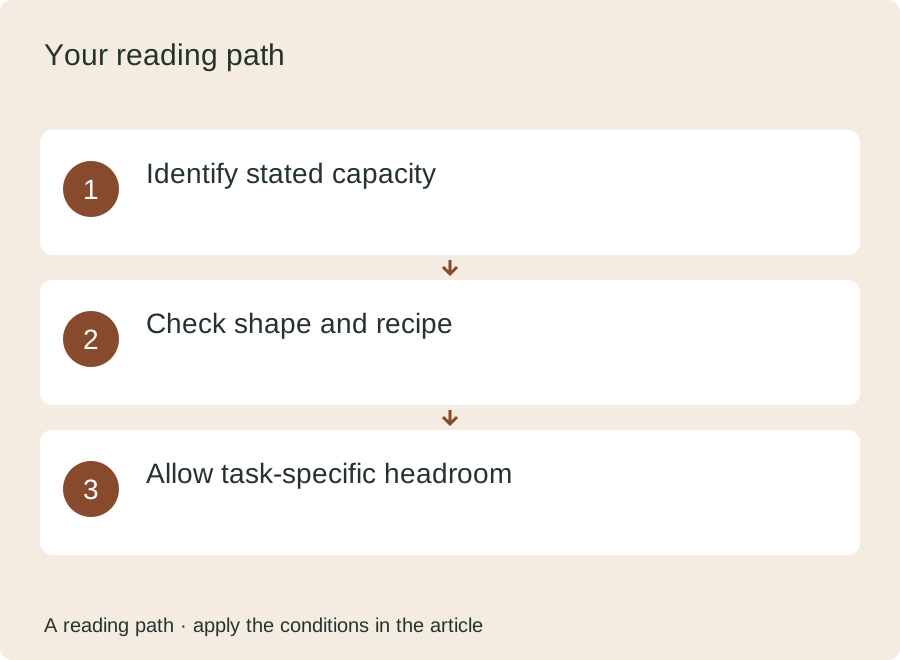
Keep a note of the original size, measured size, factor and actual quantities. That makes the next attempt reproducible. For deeper vessels, our pot capacity calculator separates geometric volume from the headroom you leave for cooking.
Practical check: what to observe
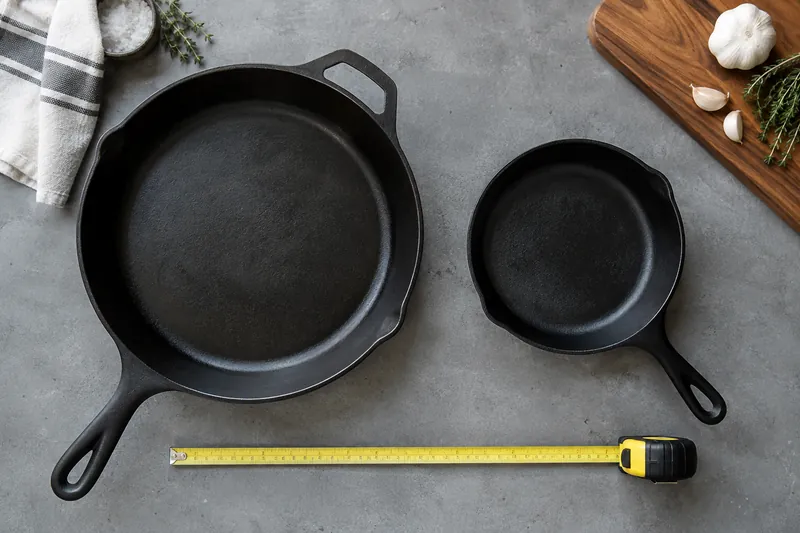
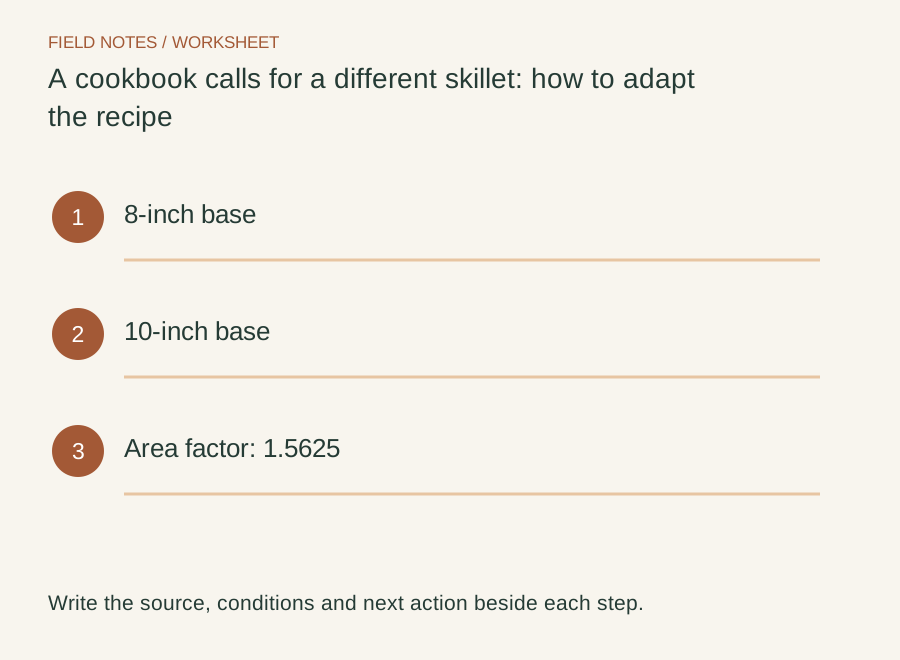
Measure the actual cooking floor of both pans, calculate the factor and note the intended food depth. If the original pan’s usable base is unknown, label your result an estimate rather than an exact recipe conversion.
- 8-inch base
- 10-inch base
- Area factor: 1.5625
Can I multiply the cooking time by the same factor?
No. Time does not scale directly with pan area. Food depth, temperature, material, heat input and the recipe’s doneness cues all matter. Follow the relevant food-safety and recipe instructions.
For more context, see the topic FAQ and glossary. A reference value or example should be read with its units, assumptions and product-specific conditions.
Sources and scope
The reading below provides context for the relevant care or brewing principles. The article’s scenarios and decision questions are original editorial explanations, not independent product tests. Read the editorial policy for sourcing, AI assistance and corrections.
- America’s Test Kitchen — Cook It in Cast Iron
Publisher information about recipes, techniques and cast-iron care; not our own recipe testing.
- Harold McGee — On Food and Cooking
Publisher description used to establish scope; no claim of a complete book review.
Put the explanation to work
Continue reading
Spot a questionable claim or a calculation issue? Read our correction process and contact information. Examples and illustrations are educational; they do not establish product suitability or a laboratory result.